Family fights muscular disease in child’s memory

July 27, 2011

Family fights muscular disease in child’s memory

The OC Register | July 24, 2011 | By Fred Swegles

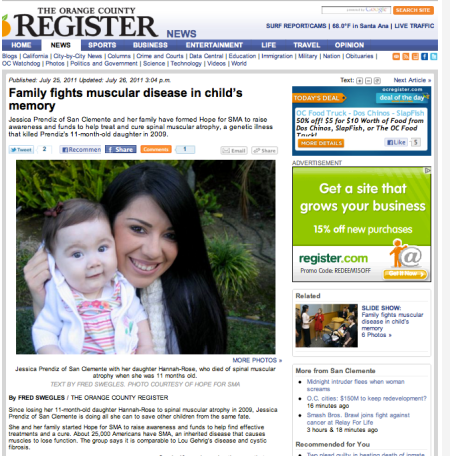
Since losing her 11-month-old daughter Hannah-Rose to spinal muscular atrophy in 2009, Jessica Prendiz of San Clemente is doing all she can to save other children from the same fate.

She and her family started Hope for SMA to raise awareness and funds to help find effective treatments and a cure. About 25,000 Americans have SMA, an inherited disease that causes muscles to lose function. The group says it is comparable to Lou Gehrig’s disease and cystic fibrosis.

Click HERE or on the image below to read more…


Pregnancy hormone has unprecedented, powerful effect on spinal muscular atrophy

July 25, 2011

Pregnancy hormone has unprecedented, powerful effect on spinal muscular atrophy

Press Release | July 25, 2011

‘Biggest increase anyone has seen’ in the production of essential compound for deadly childhood disease

OTTAWA – July 25, 2011 – Researchers in Ottawa report new hope for the treatment of infants born with serious genetic disorder.

Over 1000 children in Canada are affected with Spinal Muscular Atrophy (SMA), a genetic disorder that causes muscle weakness and loss of motor control. In its most severe form survival of children with SMA beyond 5 years is rare. Although the disorder is caused by the loss of a specific gene, all infants and children with SMA have an untouched highly similar gene within their genetic make up. Activation of this copy gene has the potential to treat SMA, and thus has been a goal of researchers around the world. Now, researchers at the Children’s Hospital of Eastern Ontario Research Institute in Ottawa report the strongest such activation yet observed with attendant benefit on mice genetically engineered to have SMA.

PhD student Faraz Farooq working in the laboratory of University of Ottawa professor, Alex MacKenzie has discovered that the pregnancy hormone Prolactin, a Canadian discovery in itself, not only activates the copy gene but if given over time extends the lifespan of SMA mice by up to 60%. The research report is published today in the Journal of Clinical Investigation.

“Prolactin causes a dramatic regulation of copy gene SMN2 which results in high production of SMN protein, resulting in the extension in the lifespan of mice with SMA,” said Mr. Faraz Farooq. “Labs around the world have been trying to produce more protein from copy gene SMN2 but with Prolactin (an insulin like protein) we’re seeing up-regulation that’s more than tenfold. It’s the biggest increase anyone has yet seen in the SMA Field with any potential therapeutic compound. This represents a significant advance in search for a therapy for this disease.”

The laboratory testing of Prolactin on SMA not only shows an extended lifespan but also improved motor control. Prolactin has been used in clinical trials for unrelated studies, so it is expected that the path between pre-clinical validation and actual clinic trials of Prolactin with SMA patients will be reasonably short.

“News of prolactin’s role and effectiveness in SMN regulation breathes fresh hope into all of the SMA community,” said Martha Slay, president and co-founder of FightSMA. “FightSMA congratulates Dr. MacKenzie and his colleagues on this exciting breakthrough in SMA research.”

“We believe we’re moving in the direction of an effective pre-symptomatic treatment of kids with SMA,” said Dr. Alex MacKenzie, principal investigator, CHEO Research Institute. “We want to somehow stop the progress of this disorder in its tracks, and let our tiniest patients build strength. Today’s findings are not curative, but we think this is a breakthrough discovery. Hopefully by using different approaches to increase SMN protein we can develop a combination therapy for the treatment of SMA.”

###

About the CHEO Research Institute: Established in 1984, the CHEO Research Institute coordinates the research activities of the Children’s Hospital of Eastern Ontario (CHEO) and is one of the institutes associated with the University of Ottawa Teaching Hospitals. The Research Institute brings together health professionals from within CHEO to share their efforts in solving paediatric health problems. It also promotes collaborative research outside the hospital with partners from the immediate community, industry and the international scientific world.

Click HERE or on the image below to read the press release…

Local family works to meet daughter’s needs

July 21, 2011

Local family works to meet daughter’s needs

New Richmond News | July 20, 2011 | By Jackie Grumish

Gabbie Bark was given just six months to live.

Thankfully that first diagnosis proved wrong, due to a general misunderstanding about Spinal Muscular Atrophy (SMA). The 2-year-old’s future is much brighter than first suspected.

That doesn’t mean her current health status and her future won’t be filled with challenges.

An inherited disease, SMA leads to the loss of muscle and motor function. The rare disease is the result of the absence of or defect in the individual’s Survival Motor Neuron 1 gene.

“One in 40 people are carriers,” explained Gabbie’s dad, Jamie. “Both me and my wife (Jackie) are carriers, so from a numbers standpoint it’s pretty rare to have both parents as carriers.”

Click HERE or on the image below to learn more…


Families of SMA Awards $3 Million in New Spinal Muscular Atrophy Research Funding

July 21, 2011

Families of SMA Awards $3 Million in New Spinal Muscular Atrophy Research Funding

FSMA (Press Release) | July 19, 2011

Families of Spinal Muscular Atrophy (FSMA) is dedicated to creating a treatment and cure for Spinal Muscular Atrophy (SMA) by funding and advancing a comprehensive research program.  The new funding awards will be allocated into three distinct research areas: 1)Basic Research to understand the disease and provide seed ideas for drug making, 2)Drug Discovery to develop new SMA therapies, and 3)Clinical Research to provide the means to test new drugs effectively.

Click HERE or on the image below to read more…


Northampton actress finds personal success despite disabilities

July 18, 2011

Northampton actress finds personal success despite disabilities

MSNBC.com via PhillyBurbs.com | July 18, 2011 | By Manasee Wagh

She has performed in Italy and off-Broadway, to glowing reviews in the New York Times. She can sing, too, and fondly recalls belting out the national anthem before a Phillies game.

A 2000 graduate of Council Rock High School, Shannon DeVido of Northampton is fulfilling her childhood dream of becoming an actress.

It just doesn’t matter that DeVido, 29, was born with spinal muscular atrophy, a degenerative disease that causes the muscles to deteriorate over time. Rather than interfering with the life she wants to lead, she said the genetic condition has felt more like a minor setback that she revels in beating.

“It’s a very interesting thing to be in a wheelchair in this business. It’s very different, and I find myself fighting all the time for parts. Actresses in wheelchairs have a challenge, getting casting directors to look past that. But it’s good to have a challenge because it makes you stronger,” she said.

While DeVido earns her living working at the Apple store in Philadelphia, her passion lies in performance. She knows her experience wouldn’t be that different even if she were up and walking around, she said.

“Every actor goes through rejection. It’s 95 percent rejection. But I love it way too much to give up. I can’t imagine myself doing anything else,” she said.

The disease isn’t something she chooses to focus on, DeVido said. “I don’t like to talk about my disability very often. It’s not my sole purpose in life. I’m not going to let it stop me,” she said.

Click HERE or on the image below to read more…


Health check on babies improved

July 18, 2011

Health check on babies improved

Leicester Mercury | July 18, 2011

A mum whose baby daughter died from a rare genetic disorder has succeeded with her campaign to bring in a training programme for health visitors.

Lucy Wright’s daughter Georgia died from muscle condition spinal muscular atrophy (SMA), aged seven months, in August 2008.

Since then, her mum, of Melton, has worked with a charity to urge NHS trusts to bring in training for health visitors which would help them to identify the condition earlier.

Leicestershire Partnership NHS Trust, which is responsible for health visitors in the county, is believed to be the first organisation in the country to bring in the training.

Lucy, 30, said: “If the training had been in place when Georgia was born, her condition might have been diagnosed earlier and it would have given her more quality of life in the time we had with her.

“I am pleased my campaign for the extra training in Leicestershire and Rutland has been a success but my work continues.

“I would like to see it introduced in every primary care trust in the country.”

Click HERE or on the image below to read more…


Gene splicing breakthrough gives hope to cystic fibrosis sufferers

July 18, 2011

Gene splicing breakthrough gives hope to cystic fibrosis sufferers

The Globe and Mail | July 15, 2011

Understanding genetic disorders like cystic fibrosis could be easier after researchers at a B.C. university made a breakthrough in gene splicing.

Stephen Rader, a chemistry professor at the University of Northern British Columbia, said researchers have discovered that an RNA molecule previously thought to play no role in gene splicing is, in fact, essential.

Researchers have also discovered a new way to study what the U4 molecule does, a problem Prof. Rader said scientists have grappled with for about three decades.

“Splicing is so important in our bodies that if anything goes wrong with it, it causes various kinds of disease, including cystic fibrosis and a whole slew of others. The idea then is that what we learn about how splicing happens normally will help us to understand what goes wrong in these diseases,” he said in an interview.

Click HERE or on the image below to read more…


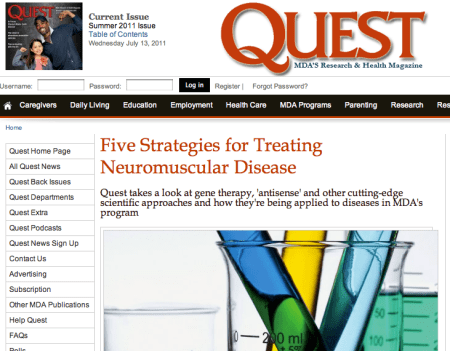
Five Strategies for Treating Neuromuscular Disease

July 14, 2011

Five Strategies for Treating Neuromuscular Disease

Quest (MDA) | July 2011 | By Amy Labbe

Article Highlights:

  • This article describes five leading therapeutic strategies currently being tried in neuromuscular disease research: antisense oligonucleotides, stem cells, small molecules, protein therapy and gene therapy.
  • These strategies are relevant in ALS, Becker MD, centronuclear myopathies/myotubular myopathy, Charcot-Marie-Tooth disease, congenital MD, Dejerine-Sottas disease, distal MD (Miyoshi myopathy), Duchenne MD, facioscapulohumeral MD, Friedreich’s ataxia, limb-girdle MD, myotonic MD and spinal muscular atrophy.
  • The strategies were the focus of an MDA scientific conference in March 2011 that was designed to help advance these strategies from “microscope to marketplace.”
Click HERE or on the image below to read more…

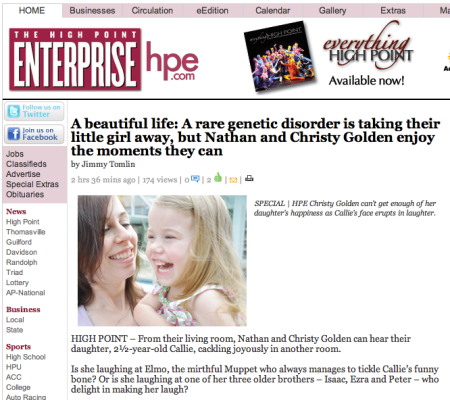
A beautiful life: A rare genetic disorder is taking their little girl away, but Nathan and Christy Golden enjoy the moments they can

July 12, 2011

A beautiful life: A rare genetic disorder is taking their little girl away, but Nathan and Christy Golden enjoy the moments they can

High Point Enterprise | July 12, 2011 | By Jimmy Tomlin

HIGH POINT – From their living room, Nathan and Christy Golden can hear their daughter, 2½-year-old Callie, cackling joyously in another room.

Is she laughing at Elmo, the mirthful Muppet who always manages to tickle Callie’s funny bone? Or is she laughing at one of her three older brothers – Isaac, Ezra and Peter – who delight in making her laugh?

Truth is, for the Goldens, it doesn’t matter what Callie’s laughing at. She’s laughing.

Meanwhile, Christy’s crying. Not wailing, mind you – just tearing up as she talks about Callie, her precious little girl with the big smile on her face, the twinkling sparkle in her eyes, the infectious joy in her laugh, and the rare genetic disorder – spinal muscular atrophy, or SMA – that’s slowly taking her life.

“We went through a very dark time where, for me, I felt totally abandoned by God,” Christy tearfully recalls. “I felt like I just begged Him to let me take her place – that I would do anything just for her to be OK. … Our dreams for her were just crushed when we learned about her diagnosis. And our assumptions, too: That she would grow up. That she would play sports with her brothers. That one day she would get married and have children.”

Looking back, Christy sees that dark period as just another part of the journey – a time when she agonized over Callie’s bleak future, to the point that she neglected Callie’s present. Gradually, that realization changed Nathan and Christy’s perspective.

“When we see how happy Callie is now,” Christy says, “when we see her playing with her brothers and going to preschool, which she loves, it helps pull us out of the future – a future we cannot even know – and to really just be present with her and for her.”

Even as they watch Callie’s tiny body betray her, Nathan and Christy have determined their daughter will not be defined by how she dies but by how she lives.

Click HERE or on the image below to read more…


Results From CARNI-VAL Clinical Trial Published: A Twelve Month Prospective, Open-label Trial of VPA and L-carnitine in Ambulatory Children with SMA

July 11, 2011

Results From CARNI-VAL Clinical Trial Published: A Twelve Month Prospective, Open-label Trial of VPA and L-carnitine in Ambulatory Children with Spinal Muscular Atrophy

FSMA | July 6, 2011

The second set of results from the Families of Spinal Muscular Atrophy funded CARNI-VAL clinical trial in ambulatory children published in PLoS ONE. The trial was completed by the Project Cure SMA Clinical Trial Network. The trial was registered at clinicaltrials.gov with identifier: NCT00227266.

Multiple lines of evidence, including treatment of patient-derived cell lines, animal models and open-label pilot human trials, have suggested that valproic acid (VPA) might have a therapeutic benefit in patients with spinal muscular atrophy. The SMA CARNIVAL TRIAL was a trial designed to evaluate the effectiveness of combined oral VPA and l-carnitine in two different groups of children with SMA. Group 1 of this trial targeted non-ambulatory SMA children 2-8 years of age, randomized to receive placebo or treatment for the first six months, then active treatment for an additional six months (Please see group 1 results in an earlier article in this issue of Compass). Group two of this study was a twelve month open-label trial of VPA and L-carnitine in ambulatory children with SMA. Group two of the study involved an ambulatory group of 33 genetically proven SMA “standers and walkers” (type 3), between the ages 3-17 years.

Participants underwent two initial baseline assessments of functional over a 4-6 week period and then were placed on VPA and L-carnitine for 12 months. Functional assessments were performed at baseline, 3, 6 and 12 months. Several primary functional assessments (outcomes / trial endpoints) were used, including safety, adverse event data, and efficacy. Efficacy (potential benefit) was measured by change in motor function at 6 and 12 months using the Modified Hammersmith Functional Motor Scale Extend (MHFMS-Extend), timed tests of gross motor function, and a fine motor module. Secondary outcome measures were tested at 6 and 12 month. These included maximum ulnar compound muscle action potential amplitudes (CMAP; see article in this issue of Compass describing what CMAP measures and indicates about motor neuron functionality), muscle strength by handheld dynamometry, pulmonary function measures, and patient and care-giver Pediatric Quality of Life Inventory scores.

Twenty-nine patients completed the 12 month open label study. VPA and carnitine were generally well tolerated, with only 1 patient developing a serious adverse event (dehydration) during the study. At least one adverse event occurred in 85% of all subjects but these were mild and similar to those seen in the group 1 study. The most common adverse events were pneumonia, gastrointestinal symptoms, fever and fractures; all except gastrointestinal symptoms were considered unlikely due to study medication. Excessive weight gain and abdominal pain were the most frequent drug-related adverse events. There was no significant change in any of the primary outcome measures at six or 12 months. There were some changes in secondary measurements. Some pulmonary function measures showed improvement at one year as expected with normal growth. CMAP amplitude did significantly improve at six and 12 months, suggesting a possible modest biologic effect directly on motor neurons, but that change was not clinically meaningful in improving participant function.

Click HERE or on the image below to read more…