A wish come true for a wheelchair-confined girl

November 5, 2011

A wish come true for a wheelchair-confined girl

WHDH-7 (NBC) | October 19, 2011

HINGHAM, Mass. — It was a wish come true for a young girl from Hingham, who is confined to a wheelchair.

The 3-year-old, who suffers from Spinal Muscular Atrophy, has always wanted a dog.

And now her wishful thinking has paid off.

The Make A Wish Foundation stepped in to find her the perfect four-legged friend

As she reached for a hug, 3-year-old Greer Ramsey greeted her new 7-month-old miniature poodle, Sparkles. All thanks to Make A Wish Foundation of Massachusetts and Rhode Island.

Click HERE or on the image below to read more…


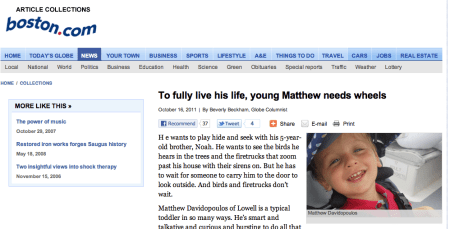
To fully live his life, young Matthew needs wheels

October 18, 2011

To fully live his life, young Matthew needs wheels

The Boston Globe | October 16, 2011 | By Beverly Beckham

H e wants to play hide and seek with his 5-year-old brother, Noah. He wants to see the birds he hears in the trees and the firetrucks that zoom past his house with their sirens on. But he has to wait for someone to carry him to the door to look outside. And birds and firetrucks don’t wait.

Matthew Davidopoulos of Lowell is a typical toddler in so many ways. He’s smart and talkative and curious and bursting to do all that he can. He loves to color and paint and play with his iPad and watch movies (“Cars’’ is his favorite). He has dark blond hair and perfect baby teeth and bright blue eyes.

It’s having spinal muscular atrophy that separates him from most kids his age. It’s being unable to sit or stand or walk or dress himself or even stamp his foot when he gets angry.

He was diagnosed with SMA when he was 8 months old, a week before Christmas. Doctors told his parents, Courtney and Paul, not only that Matthew had a degenerative muscle disease but that he would not live to be 2. They were given a Do Not Resuscitate form to fill out.

Matthew is 2 ½ now, and though his life is not easy, it’s his life. Every night his parents hook him up to a feeding tube to provide the nutrients he needs but cannot get by eating. Every morning they use a machine to clear congestion in his chest that accumulates overnight. Then they bathe and dress him and get him ready for the day. They carry him downstairs, where he has to wear a special vest for about 20 minutes to further loosen congestion. Then he is strapped into a “stander’’ for two to three hours of weight-bearing pressure on his legs. Three times a week, he has physical therapy, once a week he has play therapy and aqua therapy, and once a week he goes to a playgroup with typical kids.

All this, and he is a happy child.

Click HERE or on the image below to read more…


USC Scientist Targets the No. 1 Genetic Cause of Infant Mortality

October 18, 2011

USC Scientist Targets the No. 1 Genetic Cause of Infant Mortality

HealthCanal.com | October 13, 2011

The disease is heartbreaking. It turns babies into ragdolls and extinguishes lives just as they are getting started. But one USC scientist is working to unravel the mystery behind the leading genetic cause of infant mortality, uncovering how Spinal Muscular Atrophy disconnects muscles from the mind.

Spinal Muscular Atrophy, or SMA, is a neurodegenerative disease caused by a recessive gene mutation that results in a deficiency of the Survival of Motor Neuron, or SMN, protein. In a phenomenon called “denervation,” neurons lose their physical connection to muscles, resulting in a loss of motor control and muscle weakness.

A team of researchers lead by Chien-Ping Ko of the USC Dornsife College of Letters, Arts and Sciences has generated the first extensive study of severe denervation occurring in specific muscles affected by SMA. The data allows them to measure the effectiveness of drug treatments, and will act as a springboard for future research that explores the cause of SMA.

Click HERE or on the image below to read more…


Local 8-year-old bound to wheelchair bags first deer

October 10, 2011

Local 8-year-old bound to wheelchair bags first deer

Newark Advocate | October 9, 2011 | By Anna Sudar

BOWLING GREEN TOWNSHIP — There are no ramps in the forest.

The ground is often soggy or full of rocks and holes.

However, that doesn’t stop Cauy Sprankle from rolling through the woods in his power wheelchair to accompany his father, Chris Sprankle, on hunting and fishing trips.

On Sept. 30, the 8-year-old reached an important milestone in the life of any young hunter — killing his first deer.

With the help of his father, Cauy used a crossbow to shoot the doe from his wheelchair.

“It was a big feat for him, Chris said. “But he’s kind of a natural (at hunting).”

A third-grader at Glenford Elementary, Cauy was diagnosed with spinal muscular atrophy when he was 9 months old.

The neuromuscular disease is characterized by a progressive loss of muscle control and movement and increasing weakness.

It hasn’t slowed Cauy down.

“We try to let him do everything a normal kid would do,” Chris said. “He expects it.”

Click HERE or on the image below to read more…


Ski-a-thon celebrates Mitchell’s life

October 10, 2011

Ski-a-thon celebrates Mitchell’s life

The Daily Advance | October 8, 2011 | By Toby Tate

EURE — This year’s Haley Mitchell Ski-a-thon for Spinal Muscular Atrophy (SMA) is significant not only in the fact that it’s the last one, but also because it would have been Haley’s 14th birthday.

“It’s tough to be here this year without Haley,” said Valerie Mitchell, Haley’s mother. “Personally I just don’t have it in me to keep doing this big event.”

SMA is a deadly neuromuscular disease that deteriorates the spinal cord cells that control muscular function. Afflicted with SMA since birth, Haley was given only two years to live. She beat the odds, passing away on Oct. 26, 2010, just 2½ weeks after her 13th birthday.

Haley’s father Jeff Mitchell, who was waterskiing at Saturday’s event at Beaver Lake in Gates County, said he was happy with the turnout and the support they have received over the years. To date, the ski-a-thon has raised about $400,000 for Families of SMA, according to Mitchell.

Click HERE or on the image below to read more…


NIH Undiagnosed Diseases Program documents two-year pilot as clinic of last resort

October 10, 2011

NIH Undiagnosed Diseases Program documents two-year pilot as clinic of last resort

HealthCanal.com | October 6, 2011

Genomic tools prove integral to solving medical mysteries

After its first two years of work, the Undiagnosed Diseases Program (UDP) of the National Institutes of Health is citing successes in patients whose cases have stumped specialists at leading medical institutions around the country. The researchers published the program’s first retrospective analysis in the Sept. 26, 2011 early online issue of Genetics in Medicine.

The successes include the diagnoses of siblings whose calcium-riddled blood vessels made it excruciatingly painful to walk, a woman with life-threatening protein deposits in her muscles and a 20-year-old whose diagnosis makes him the oldest survivor of his previously undiagnosed muscle and lung disorder.

“The UDP responds to a critical unmet need, with compassion, clinical expertise and state of the art genomic technologies,”” said Daniel Kastner, M.D., Ph.D. , scientific director at the National Human Genome Research Institute (NHGRI). “A patient who cannot be diagnosed may cycle through the medical system with no satisfactory treatment plan or be abandoned by the medical system. Through the UDP, NIH provides a glimmer of hope to patients and their families, while at the same time gaining remarkable medical insights.”

The UDP is supported by the NIH Office of the Director, NHGRI, the NIH Office of Rare Diseases Research (ORDR) and the NIH Clinical Center.

The report focuses on 160 patients of the total 326 cases accepted into the program. More than half of the accepted patients had undiagnosed neurological problems. Other prominent disorder categories include gastrointestinal disease; fibromyalgia and chronic fatigue syndrome; immune-mediated and rheumatic illnesses; psychiatric conditions; pain; dermatologic disorders; and cardiovascular disease.

So far, most of the solved cases — 37 of 39 cases for which the UDP team arrived at a diagnosis — involved diseases previously encountered in the world of medicine, according to UDP authors. In general, about 500 diseases are common enough to be in any physician’s repertoire for diagnosis, while another 6,500 are known but are exceptionally rare, according to ORDR data.

UDP researchers reviewed, evaluated and diagnosed 23 patients with rare diseases, of which 15 cases reflect extremely rare diseases affecting fewer than 10,000 people. The authors note that while these are known disorders, some lack diagnostic tests or medical definitions to describe them. Rare diseases are defined as those affecting fewer than 200,000 people in the United States.

The program has also delved into the realm of unknown maladies. In February, the UDP announced the program’s first discovery of a new disease, called ACDC, or arterial calcification due to deficiency of CD73, in the New England Journal of Medicine. CD73 is a protein that produces a small molecule, adenosine, which protects arteries from calcifying. A report on one additional new disorder is pending publication.

The siblings whose cases led to discovery of ACDC continue to experience pain while walking more than a short distance. The NIH researchers, however, have obtained approval to start a drug treatment protocol that could improve their condition, which will be initiated within months.

The patient who UDP researchers encountered with an unexplained muscle condition was diagnosed with a rare form of amyloidosis, a condition in which bone marrow produces excess immunoglobulin proteins, which had accumulated in the patient’s muscle tissue. The NIH team referred the patient for a stem-cell, bone marrow transplant, using healthy donor stem cells. The patient has subsequently experienced progressive improvement in her condition.

The UDP team also succeeded in diagnosing the 20-year-old patient with a condition called spinal muscular atrophy with respiratory distress. The condition causes damage to muscles, including respiratory muscles. The patient remains dependent on a respirator for much of his day but last year achieved the significant personal milestone of high school graduation. The diagnosis has allayed the patient’s concern that the condition might at any point impair his learning.

Click HERE or on the image below to learn more…


Antisense therapy delivers long-term correction of severe spinal muscular atrophy in mice

October 5, 2011

Antisense therapy delivers long-term correction of severe spinal muscular atrophy in mice

Press Release | October 5, 2011

Findings reveal that deficiency of the SMN protein in peripheral tissues might also contribute to SMA pathology

Cold Spring Harbor, N.Y. – A new study from Cold Spring Harbor Laboratory (CSHL) reports surprising results that suggest that the devastating neuromuscular disease, spinal muscular atrophy (SMA), might not exclusively affect the motor neurons in the spinal cord as has long been thought. The new findings suggest that defects in peripheral tissues such as liver, muscle, heart, etc., might also contribute to the pathology of the disease in severely affected patients. The study, which also paves the way for a potential SMA drug to enter human trials by the end of the year, appears in Nature on October 6.

These insights stem from experiments that tested the new candidate drug, which the CSHL scientists helped develop, in a mouse model of very severe SMA. In this system, the candidate drug dramatically suppressed symptoms when simply injected under the animals’ skin. “These systemic, or subcutaneous, injections, extended the lifespan of mice that have the equivalent of severe human SMA by 25-fold,” reports CSHL’s Professor Adrian Krainer, Ph.D., who led the CSHL team in collaboration with a group led by Dr. Frank Bennett of California-based Isis Pharmaceuticals.

“However, we have yet to determine whether these findings are unique to this animal model of severe SMA—and by extension, relevant only to the patients with the most severe disease —or if they will be valid in other SMA types that manifest with milder, less severe symptoms,” cautions Dr. Bennett.

Click HERE or on the image below to read more…


Don’t be charitable about jobs bill

October 5, 2011

Don’t be charitable about jobs bill

The Charleston Gazette | October 5, 2011 | By Craig D. Eyermann

President Obama revived one of his favorite revenue-raising proposals in his recent jobs plan: limiting the itemized tax deductions that “millionaires and billionaires” (defined as individuals earning over $200,000 or couples earning more than $250,000 per year) can take for mortgage interest, state and local taxes, and charitable contributions.

By the White House’s calculations, this modest move would raise 86.9 percent of the $467 billion needed to pay for the jobs plan over the next 10 years.

While the White House’s revenue calculations are highly questionable, what aren’t questionable are the consequences of the president’s proposal.

According to Internal Revenue Service figures, individuals claimed nearly $34.9 billion in charitable deductions on their federal tax returns in 2009. Households reporting $200,000 or more in annual income claimed $19.14 billion, or 54.9 percent, of these deductions.

Prior to the new jobs initiative, the president previously had gone after the charitable deduction in his fiscal 2012 budget proposal. That proposal called for limiting the tax deduction for high-income earners by as much as 30 percent.

So let’s recognize reality and do some simple math. Here is the reality: at least some well-to-do households will reduce their charitable donations if the tax deduction is cut, because more of their money will go to government, making less available for charity. Logically, at least some fraction of the $19.14 billion now going to charity would disappear.

Now for the math: a 5 percent reduction in charitable giving by those claiming a tax deduction in 2009 would have reduced total contributions by $957 million. A 20 percent drop in giving would have reduced charitable contributions by $3.8 billion.

There are those, including some in the White House, who think government should do everything. But government’s track record is less than exemplary. The president’s attempt to go after the wealthy by going after the tax deduction for charitable contributions will have real human costs.

Consider the case of former Goldman Sachs partner Dinakar Singh, whose daughter was diagnosed in 2001 at 19 months old with Spinal Muscular Atrophy. The condition causes the nerve cells that control the body’s muscles to deteriorate, with severe cases causing death within a few years and less severe cases requiring substantial supportive care over the patient’s lifetime.

Click HERE or on the image below to read more…


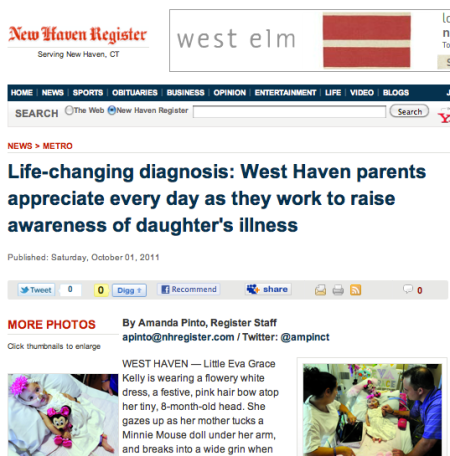
Life-changing diagnosis: West Haven parents appreciate every day as they work to raise awareness of daughter’s illness

October 3, 2011

Life-changing diagnosis: West Haven parents appreciate every day as they work to raise awareness of daughter’s illness

New Haven Register | October 1, 2011 | By Amanda Pinto

WEST HAVEN — Little Eva Grace Kelly is wearing a flowery white dress, a festive, pink hair bow atop her tiny, 8-month-old head. She gazes up as her mother tucks a Minnie Mouse doll under her arm, and breaks into a wide grin when her dad kisses her face.

It’s the kind of scene parents everywhere enjoy with their babies; the difference is the setting.

Eva is in the Pediatric Intensive Care Unit at Yale-New Haven Hospital. She’s been there for seven weeks, and her parents, West Haveners John and Melissa Kelly, don’t know when or if she will get to come home.

Eva has spinal muscular atrophy, a rare motor neuron disease that affects muscles used for crawling, walking and swallowing, and keeps Eva from being able to cough.

She has the most severe form, Melissa Kelly said, and babies with her diagnosis commonly don’t live past the age of 2. She was taken to the hospital to be fitted with a feeding tube, and then contracted an illness that led to a collapsed lung, which a breathing tube now keeps inflated, John Kelly said.

It is emotional to visit a wide-eyed baby afflicted with a “horrible” disease, so Melissa Kelly and her husband have decorated the room with brightly colored pictures, balloons and stuffed animals.

Click HERE or on the image below to read more…


Vaqueros Team Up With Gwendolyn Strong Foundation

September 28, 2011

Vaqueros Team Up With Gwendolyn Strong Foundation

KEYT-3 (ABC) | September 27, 2011 | By Mike Klan

Vodpod videos no longer available.

Santa Barbara City College Football has a new community outreach campaign called The Vaquero Honorary Captain Program. This year they are celebrating examples of strength, courage and spirit by honoring and raising awareness for individuals and/or groups. This past Saturday Gwendolyn Strong served as honorary captain during their game against Moorpark. Gwendolyn, who is almost four years old, has Spinal Muscular Atrophy (SMA), the #1 genetic killer of babies. SMA is degenerative and fatal. Most people with SMA do not live past two years old. For more information on this disease, visit ENDSMA.org.

Click HERE or on the image below to see story and video on the KEYT-3 website…