USC Scientist Targets the No. 1 Genetic Cause of Infant Mortality

October 18, 2011

USC Scientist Targets the No. 1 Genetic Cause of Infant Mortality

HealthCanal.com | October 13, 2011

The disease is heartbreaking. It turns babies into ragdolls and extinguishes lives just as they are getting started. But one USC scientist is working to unravel the mystery behind the leading genetic cause of infant mortality, uncovering how Spinal Muscular Atrophy disconnects muscles from the mind.

Spinal Muscular Atrophy, or SMA, is a neurodegenerative disease caused by a recessive gene mutation that results in a deficiency of the Survival of Motor Neuron, or SMN, protein. In a phenomenon called “denervation,” neurons lose their physical connection to muscles, resulting in a loss of motor control and muscle weakness.

A team of researchers lead by Chien-Ping Ko of the USC Dornsife College of Letters, Arts and Sciences has generated the first extensive study of severe denervation occurring in specific muscles affected by SMA. The data allows them to measure the effectiveness of drug treatments, and will act as a springboard for future research that explores the cause of SMA.

Click HERE or on the image below to read more…


Vaqueros Team Up With Gwendolyn Strong Foundation

September 28, 2011

Vaqueros Team Up With Gwendolyn Strong Foundation

KEYT-3 (ABC) | September 27, 2011 | By Mike Klan

Vodpod videos no longer available.

Santa Barbara City College Football has a new community outreach campaign called The Vaquero Honorary Captain Program. This year they are celebrating examples of strength, courage and spirit by honoring and raising awareness for individuals and/or groups. This past Saturday Gwendolyn Strong served as honorary captain during their game against Moorpark. Gwendolyn, who is almost four years old, has Spinal Muscular Atrophy (SMA), the #1 genetic killer of babies. SMA is degenerative and fatal. Most people with SMA do not live past two years old. For more information on this disease, visit ENDSMA.org.

Click HERE or on the image below to see story and video on the KEYT-3 website…


Cedars-Sinai Opens New Induced Pluripotent Stem Cell Core Production Facility

September 22, 2011

Cedars-Sinai Opens New Induced Pluripotent Stem Cell Core Production Facility

Press Release | September 21, 2011

Newswise — LOS ANGELES – Sept. 21, 2011 – The Cedars-Sinai Regenerative Medicine Institute has opened a new Induced Pluripotent Stem Cell (iPSC) Core Facility to produce powerful cells capable of making all tissues of the body from adult human skin cells.

One of the first to open in California, cells produced by the Cedars-Sinai core will be used in research funded by the National Institutes of Health and the California Institute for Regenerative Medicine. The cells will be critical for innovative research aimed at increasing our understanding of human diseases and genetic disorders, and the quest for new treatments.

“The opening of the Cedars-Sinai Stem Cell Core Facility underscores what an exciting time this is in regenerative medicine,” said Shlomo Melmed, MD, senior vice president of academic affairs and dean of the faculty at Cedars-Sinai. “It also is an example of Cedars-Sinai’s deep commitment to the scientific research that will be translated into tomorrow’s leading-edge treatments.”

The new facility will use the latest technology to generate induced pluripotent stem cells from a patient skin scraping. The induced pluripotent stem cells can be replicated indefinitely and have biological properties similar to embryonic stem cells. These “blank slate” cells can then be turned into any kind of differentiated cell, such as a brain cell or an eye cell or a liver cell.

Although iPS cells were first produced only three years ago, they have quickly become valuable research tools. Clinicians can take skin cells from patients with specific life threatening diseases. Then, Regenerative Medicine Institute scientists can create iPS cells from them and then generate so-called “disease in a dish” models that enable them to more easily identify effective therapies.

Click HERE or on the image below to read more…


Ipierian Hires New CEO to Carry on With Stem Cells for Discovering Neurological Drugs

September 8, 2011

Ipierian Hires New CEO to Carry on With Stem Cells for Discovering Neurological Drugs

xconomy | September 7, 2011 | By Luke Timmerman

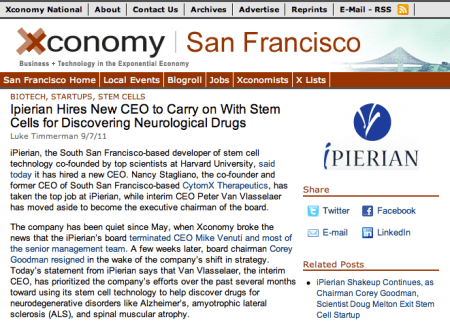
iPierian, the South San Francisco-based developer of stem cell technology co-founded by top scientists at Harvard University, said today it has hired a new CEO. Nancy Stagliano, the co-founder and former CEO of South San Francisco-based CytomX Therapeutics, has taken the top job at iPierian, while interim CEO Peter Van Vlasselaer has moved aside to become the executive chairman of the board.

The company has been quiet since May, when Xconomy broke the news that the iPierian’s board terminated CEO Mike Venuti and most of the senior management team. A few weeks later, board chairman Corey Goodman resigned in the wake of the company’s shift in strategy. Today’s statement from iPierian says that Van Vlasselaer, the interim CEO, has prioritized the company’s efforts over the past several months toward using its stem cell technology to help discover drugs for neurodegenerative disorders like Alzheimer’s, amyotrophic lateral sclerosis (ALS), and spinal muscular atrophy.

Click HERE or on the image below to read more…


Fundraiser turns light on little-known illness

August 12, 2011

Fundraiser turns light on little-known illness

The Sacramento Bee | August 11, 2011 | By Ben Schenkel

Getty Storm is wide-eyed, like most babies. But another unusual trait inspired her parents, Mark Storm and Kate Mathany, to nickname her “owl.”

“She has this depth and wisdom about her – like she was born an old soul,” Mathany said.

Getty shares more with an owl than her calmness and concentrated gaze. Sixteen months old and the namesake of the Getty Owl Foundation, Getty is limited to hooting and cooing. Beginning words like “mama” or “da-da” elude her – and she may never be able to talk.

Getty inherited spinal muscular atrophy (SMA), a genetic disorder that will eventually claim her vocal cords. Just as Getty defies SMA with her every chirp, so have her parents spoken up about the crippling condition.

In March, Storm and Mathany started a foundation to raise local awareness of SMA and support the larger efforts to cure or mitigate it.

Click HERE or on the image below to read more…


Family fights muscular disease in child’s memory

July 27, 2011

Family fights muscular disease in child’s memory

The OC Register | July 24, 2011 | By Fred Swegles

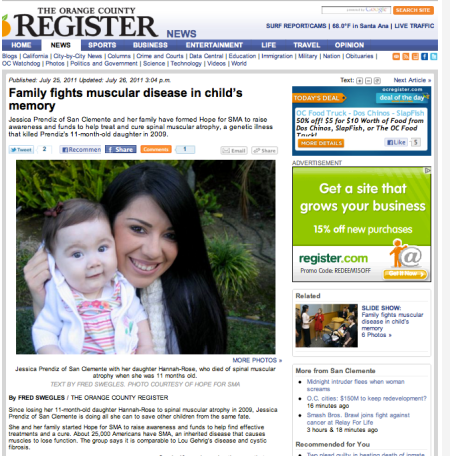
Since losing her 11-month-old daughter Hannah-Rose to spinal muscular atrophy in 2009, Jessica Prendiz of San Clemente is doing all she can to save other children from the same fate.

She and her family started Hope for SMA to raise awareness and funds to help find effective treatments and a cure. About 25,000 Americans have SMA, an inherited disease that causes muscles to lose function. The group says it is comparable to Lou Gehrig’s disease and cystic fibrosis.

Click HERE or on the image below to read more…


Stem-Cell Gamble

June 21, 2011

Stem-Cell Gamble

Technology Review (MIT) | June 21, 2011 | By Antonio Regalado

Hans Keirstead wakes up every morning at his home near Los Angeles and checks CNN. He’s looking for news about the first-ever human test of embryonic stem cells, launched in October by the biotechnology firm Geron. Mostly, he’s looking for bad news. “If someone dies, or is in pain, then it’s over,” he says, pushing a hand through his tawny hair. Keirstead, dressed in a loose linen shirt and wearing a thumb ring, is a biologist at the University of California, Irvine, who has variously been called the “rock star,” “miracle worker,” and “Pied Piper” of stem-cell science. Today he has a corner office in a new $67 million research center paid for in part by California voters, whom he helped persuade to vote for a $3 billion stem-cell spending plan in 2004 with a video of partially paralyzed rats walking again after stem-cell transplants performed in his laboratory.

That same treatment is now being tested in human beings. No wonder Keirstead is anxious. Although he is not directly involved in the clinical trial, the discovery he patented, promoted to Californians, and later licensed to Geron has now become the leading test of whether embryonic stem cells will finally live up to their medical potential. “I’m dying to know if it works,” he says.

Click HERE or on the image below to read more…


Despite losing use of arms, CSULA student achieves bachelor’s degree in graphic design

June 15, 2011

Despite losing use of arms, CSULA student achieves bachelor’s degree in graphic design

Alhambra Source | June 15, 2011 | By Margie Low

Alhambra resident Todd Tostado, who lost the use of his arms at age 14 as a result of spinal muscular atrophy, received his bachelor’s degree in art at Cal State Los Angeles this past weekend.

Tostado, who also has been using a ventilator since he was nine due to chronic respiratory failure, enjoyed drawing as a child, but eventually could not use his hands to draw due to the neuromuscular disease that progressively weakened his muscles. His parents bought him his first computer during his senior year at Alhambra High School, and there he began his quest to express himself creatively. With assistive technology, he was able to design and create art digitally.

After graduating from high school, he took art classes at Pasadena City College, then went on to pursue a baccalaureate degree in graphic design at CSULA.

Click HERE or on the image below to learn more…


Couple wants to spread the word about little known genetic disorder

June 10, 2011

Couple wants to spread the word about little known genetic disorder

The Acorn | June 9, 2011 | By Sylvie Belmond

A young local couple who wanted to start a family saw their dreams dashed when they learned they both carry a little-known genetic defect that kills more children than any other inherited disease.

A month after their storybook wedding in Santa Barbara in May 2010, Stephanie and Brandon Humes decided to start a family.

“ We both just really love children,” said Stephanie Humes, who grew up in Calabasas. “Even on our first date we talked about children. It was important to us to have a family young so we could travel with our kids and do fun things,” she said.

To ensure that their baby would be healthy, the couple visited an obstetrician who offered a long list of genetic tests, including one for spinal muscle atrophy (SMA).

Most children who have Type 1 spinal muscle atrophy die before age 3 due to muscle weakness and atrophy.

Although Stephanie and Brandon had never heard of SMA, she said she opted to get the test because it was one of the top three suggestions on her doctor’s list.

When results showed that she’s a carrier of the defective gene, the doctor suggested that Brandon also be tested.

His test also came back positive.

Click HERE or on the image below to read more…


Cutting-Edge Research Saves Local Boy’s Life

May 24, 2011

Cutting-Edge Research Saves Local Boy’s Life

Danville Patch | May 22, 2011 | By Sarah Frank

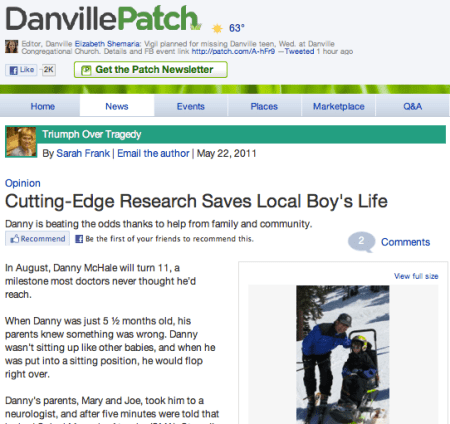
In August, Danny McHale will turn 11, a milestone most doctors never thought he’d reach.

When Danny was just 5 ½ months old, his parents knew something was wrong. Danny wasn’t sitting up like other babies, and when he was put into a sitting position, he would flop right over.

Danny’s parents, Mary and Joe, took him to a neurologist, and after five minutes were told that he had Spinal Muscular Atrophy (SMA), Stage II, and to take him home and enjoy him while they could. They were told Danny was what doctors termed a “weak type II” because he did eventually sit with assistance as a baby.

They got the devastating news no parents want to hear—it was terminal. They were told their Danny had three to six months to live, and they should make sure to get him baptized.

Click HERE or on the image below to read more…