Gwendolyn Strong Foundation Freshens Brand, Launches New Website and Online Store

November 8, 2011

Gwendolyn Strong Foundation Freshens Brand, Launches New Website and Online Store

Press Release | November 7, 2011

The Gwendolyn Strong Foundation (theGSF), a Santa Barbara-based nonprofit organization dedicated to increasing global awareness of Spinal Muscular Atrophy (SMA), the #1 genetic killer of young children, and accelerating research focused on ending this cruel disease, has refreshed its brand and launched a new website, blog, and online store offering trendy merchandise featuring their new “NEVER GIVE UP.” slogan.

“We received our nonprofit exemption in August 2009 and since then we have accomplished so much,” said Victoria Strong, theGSF co-founder. “With the support of countless around the globe, we’ve raised nearly $1 Million, increased awareness of SMA, and have had a material impact on this brutal disease. But there is still much work to be done. Children with SMA never give up and neither will we. Our new brand and online presence clearly reflects where we’ve been and paves the way for our strategic direction as we look to the future.”

To explore the new theGSF website, please visit http://theGSF.org.

To browse the new theGSF shop, please visit http://theGSF.org/shop.

To make a tax-deductible donation to theGSF, please visit http://theGSF.org/donate.

About SMA: SMA is a terminal, degenerative genetic disease that impacts the voluntary muscles in infants and children, including the ability to walk, sit, stand, eat, breathe, and even swallow, while cognitive ability is never affected. Ninety percent of children born with SMA die before the age of two. One in every 40 people or nearly 175 Million globally unknowingly carry the gene responsible for SMA. There is currently no treatment or cure and although SMA research is underfunded, it is extremely advanced. theGSF is focused on helping ensure resources are not the obstacle in attaining that cure.

About Gwendolyn Strong Foundation (theGSF) – theGSF is based in Santa Barbara, California and seeks to increase awareness and research funding for Spinal Muscular Atrophy (SMA), the leading genetic killer of young children. To learn more about SMA and theGSF, please visit http://theGSF.org.

Click HERE or on the image below to read more…

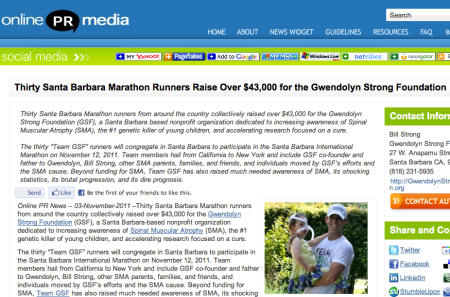
Thirty Santa Barbara Marathon Runners Raise Over $43,000 for the Gwendolyn Strong Foundation

November 5, 2011

Thirty Santa Barbara Marathon Runners Raise Over $43,000 for the Gwendolyn Strong Foundation

Press Release | November 4, 2011

Online PR News – 03-November-2011 –Thirty Santa Barbara Marathon runners from around the country collectively raised over $43,000 for the Gwendolyn Strong Foundation (GSF), a Santa Barbara-based nonprofit organization dedicated to increasing awareness of Spinal Muscular Atrophy (SMA), the #1 genetic killer of young children, and accelerating research focused on a cure.

The thirty “Team GSF” runners will congregate in Santa Barbara to participate in the Santa Barbara International Marathon on November 12, 2011. Team members hail from California to New York and include GSF co-founder and father to Gwendolyn, Bill Strong, other SMA parents, families, and friends, and individuals moved by GSF’s efforts and the SMA cause. Beyond funding for SMA, Team GSF has also raised much needed awareness of SMA, its shocking statistics, its brutal progression, and its dire prognosis.

“To say we’re humbled by what the thirty inspiring Team GSF Santa Barbara Marathon runners have accomplished would be an enormous understatement,” said Bill Strong, GSF co-founder. “There is something unbelievably powerful about a group of individuals coming together to challenge and push their physical strength to the limits to help conquer a disease that robs children of theirs. We’ve all committed to running because we can and we’re running so one day those with SMA can too.”

Click HERE or on the image below to read more…


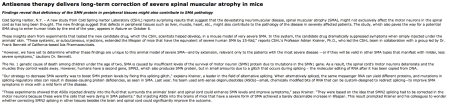
Antisense therapy delivers long-term correction of severe spinal muscular atrophy in mice

October 5, 2011

Antisense therapy delivers long-term correction of severe spinal muscular atrophy in mice

Press Release | October 5, 2011

Findings reveal that deficiency of the SMN protein in peripheral tissues might also contribute to SMA pathology

Cold Spring Harbor, N.Y. – A new study from Cold Spring Harbor Laboratory (CSHL) reports surprising results that suggest that the devastating neuromuscular disease, spinal muscular atrophy (SMA), might not exclusively affect the motor neurons in the spinal cord as has long been thought. The new findings suggest that defects in peripheral tissues such as liver, muscle, heart, etc., might also contribute to the pathology of the disease in severely affected patients. The study, which also paves the way for a potential SMA drug to enter human trials by the end of the year, appears in Nature on October 6.

These insights stem from experiments that tested the new candidate drug, which the CSHL scientists helped develop, in a mouse model of very severe SMA. In this system, the candidate drug dramatically suppressed symptoms when simply injected under the animals’ skin. “These systemic, or subcutaneous, injections, extended the lifespan of mice that have the equivalent of severe human SMA by 25-fold,” reports CSHL’s Professor Adrian Krainer, Ph.D., who led the CSHL team in collaboration with a group led by Dr. Frank Bennett of California-based Isis Pharmaceuticals.

“However, we have yet to determine whether these findings are unique to this animal model of severe SMA—and by extension, relevant only to the patients with the most severe disease —or if they will be valid in other SMA types that manifest with milder, less severe symptoms,” cautions Dr. Bennett.

Click HERE or on the image below to read more…


New Class of Stem Cell-Like Cells Discovered in Spinal Cord Offers Possibilities for Spinal Cord Repair

September 15, 2011

New Class of Stem Cell-Like Cells Discovered in Spinal Cord Offers Possibilities for Spinal Cord Repair

Press Release | September 15, 2011

SEATTLE, Sept. 15, 2011 /PRNewswire/ — The Allen Institute for Brain Science announced today the discovery of a new class of cells in the spinal cord that act like neural stem cells, offering a fresh avenue in the search for therapies to treat spinal cord injury and disease. The published collaborative study, authored by scientists from the University of British Columbia, the Allen Institute for Brain Science and The Montreal Neurological Institute and Hospital at McGill University and titled “Adult Spinal Cord Radial Glia Display a Unique Progenitor Phenotype,” appears in the open access journal PLoS One.

The research team utilized the Allen Spinal Cord Atlas, a finely detailed genome-wide map of gene expression throughout the mouse spinal cord, to compare the genes expressed, or turned on, in adult spinal cord radial glia with those found in other neural stem cells, revealing a signature set of 122 genes that indicate the likeness of these cells to classic neural stem cells.

The nervous system has historically been thought to be incapable of repairing itself, as the cells used to create it are exhausted during development. With the identification of these new stem cell-like radial glial cells, it may be possible to activate a certain set of genes in order to encourage those cells to reconstruct a damaged network in the adult spinal cord.

“By using the Allen Spinal Cord Atlas, we were able to discover a brand new cell type that has previously been overlooked and that could be an important player in all manner of spinal cord injury and disease, including multiple sclerosis and ALS,” said Jane Roskams, Ph.D., neuroscientist at the University of British Columbia and senior author of the study.

From disabled veterans to those afflicted with Lou Gehrig’s disease (ALS) or Spinal Muscular Atrophy, spinal cord related diseases and disorders affect people of all ages including nearly one-quarter of a million Americans who have suffered from a spinal cord injury; as many as 30,000 Americans who suffer from ALS at any given time; and approximately 2.5 million people worldwide who suffer from multiple sclerosis.

Click HERE or on the image below to read more…


At AACC Clinical Lab Expo, Quest Unveils Extensions to Women’s Health, Personalized Medicine Test

August 12, 2011

At AACC Clinical Lab Expo, Quest Unveils Extensions to Women’s Health, Personalized Medicine Test

Press Release | August 2, 2011

Quest Diagnostics Inc. unveiled extensions to its women’s health and AccuType® pharmacogenetic test menus and gave eight scientific presentations and host six scientific speakers during the American Association of Clinical Chemistry (AACC) Annual Meeting and Clinical Lab Expo.

The extensions to the company’s women’s health menu feature Athena Diagnostics’ spinal muscular atrophy (SMA) testing menu, believed to be the most comprehensive in the diagnostics industry. The services, which include adult-carrier screening and pre- and post-natal disease assessment testing, are now nationally available for the first time to physicians, laboratory directors and other clients of Quest Diagnostics. The offerings also position Quest Diagnostics as the only national major laboratory to provide testing services to assess SMA disease severity based on Athena’s analysis of the number of copies of an SMA-associated gene.

Athena Diagnostics, which Quest Diagnostics acquired in April 2011, is a provider of neurology diagnostics and a pioneer in SMA testing, which it has performed since 1996. Prior to the acquisition, select Quest Diagnostics’ business units had offered Athena Diagnostics’ SMA testing services in select regions only.

The SMA adult-carrier screening test detects defects in the survival motor neuron (SMN) 1 gene, which determines an individual’s risk of passing SMA to offspring. The pre- and post-natal disease assessment tests identify the number of copies of the SMN2 gene, which affects disease severity.

Click HERE or on the image below to read more…


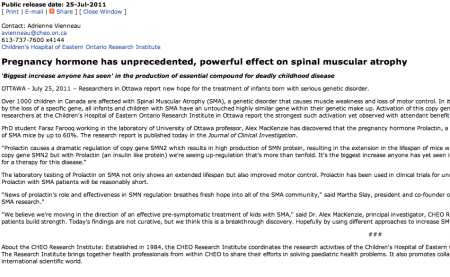
Pregnancy hormone has unprecedented, powerful effect on spinal muscular atrophy

July 25, 2011

Pregnancy hormone has unprecedented, powerful effect on spinal muscular atrophy

Press Release | July 25, 2011

‘Biggest increase anyone has seen’ in the production of essential compound for deadly childhood disease

OTTAWA – July 25, 2011 – Researchers in Ottawa report new hope for the treatment of infants born with serious genetic disorder.

Over 1000 children in Canada are affected with Spinal Muscular Atrophy (SMA), a genetic disorder that causes muscle weakness and loss of motor control. In its most severe form survival of children with SMA beyond 5 years is rare. Although the disorder is caused by the loss of a specific gene, all infants and children with SMA have an untouched highly similar gene within their genetic make up. Activation of this copy gene has the potential to treat SMA, and thus has been a goal of researchers around the world. Now, researchers at the Children’s Hospital of Eastern Ontario Research Institute in Ottawa report the strongest such activation yet observed with attendant benefit on mice genetically engineered to have SMA.

PhD student Faraz Farooq working in the laboratory of University of Ottawa professor, Alex MacKenzie has discovered that the pregnancy hormone Prolactin, a Canadian discovery in itself, not only activates the copy gene but if given over time extends the lifespan of SMA mice by up to 60%. The research report is published today in the Journal of Clinical Investigation.

“Prolactin causes a dramatic regulation of copy gene SMN2 which results in high production of SMN protein, resulting in the extension in the lifespan of mice with SMA,” said Mr. Faraz Farooq. “Labs around the world have been trying to produce more protein from copy gene SMN2 but with Prolactin (an insulin like protein) we’re seeing up-regulation that’s more than tenfold. It’s the biggest increase anyone has yet seen in the SMA Field with any potential therapeutic compound. This represents a significant advance in search for a therapy for this disease.”

The laboratory testing of Prolactin on SMA not only shows an extended lifespan but also improved motor control. Prolactin has been used in clinical trials for unrelated studies, so it is expected that the path between pre-clinical validation and actual clinic trials of Prolactin with SMA patients will be reasonably short.

“News of prolactin’s role and effectiveness in SMN regulation breathes fresh hope into all of the SMA community,” said Martha Slay, president and co-founder of FightSMA. “FightSMA congratulates Dr. MacKenzie and his colleagues on this exciting breakthrough in SMA research.”

“We believe we’re moving in the direction of an effective pre-symptomatic treatment of kids with SMA,” said Dr. Alex MacKenzie, principal investigator, CHEO Research Institute. “We want to somehow stop the progress of this disorder in its tracks, and let our tiniest patients build strength. Today’s findings are not curative, but we think this is a breakthrough discovery. Hopefully by using different approaches to increase SMN protein we can develop a combination therapy for the treatment of SMA.”

###

About the CHEO Research Institute: Established in 1984, the CHEO Research Institute coordinates the research activities of the Children’s Hospital of Eastern Ontario (CHEO) and is one of the institutes associated with the University of Ottawa Teaching Hospitals. The Research Institute brings together health professionals from within CHEO to share their efforts in solving paediatric health problems. It also promotes collaborative research outside the hospital with partners from the immediate community, industry and the international scientific world.

Click HERE or on the image below to read the press release…


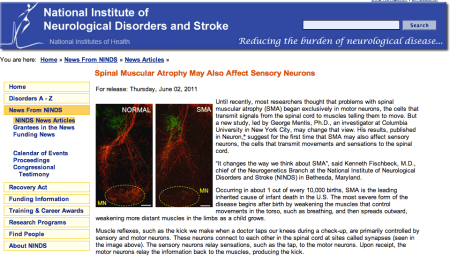
Spinal Muscular Atrophy May Also Affect Sensory Neurons

June 13, 2011

Spinal Muscular Atrophy May Also Affect Sensory Neurons

National Institute of Neurological Disorders and Stroke (NINDS) | June 2, 2011

Until recently, most researchers thought that problems with spinal muscular atrophy (SMA) began exclusively in motor neurons, the cells that transmit signals from the spinal cord to muscles telling them to move. But a new study, led by George Mentis, Ph.D., an investigator at Columbia University in New York City, may change that view. His results, published in Neuron,* suggest for the first time that SMA may also affect sensory neurons, the cells that transmit movements and sensations to the spinal cord.

“It changes the way we think about SMA”, said Kenneth Fischbeck, M.D., chief of the Neurogenetics Branch at the National Institute of Neurological Disorders and Stroke (NINDS) in Bethesda, Maryland.

Click HERE or on the image below to read more…


Families of Spinal Muscular Atrophy Announces Repligen Corporation Receives FDA Approval to Begin Phase I Safety Study

May 23, 2011

Families of Spinal Muscular Atrophy Announces Repligen Corporation Receives FDA Approval to Begin Phase I Safety Study

Press Release | May 19, 2011

Families of Spinal Muscular Atrophy announced today that Repligen Corporation has received approval from the U.S. Food and Drug Administration to commence a Phase I safety study in healthy volunteers for RG3039, formerly called Quinazoline495, which is being developed for Spinal Muscular Atrophy.

FSMA began the Quinazoline program in 2000 at the very initial stages of drug development, when risk is the highest. It was the very first industrial drug program for SMA ever conducted. FSMA fully funded the program with investments of $13 Million. The direction from FSMA provided the positive results necessary to license the program to Repligen Corporation and leverage larger funding for clinical development.

This clinical trial will be a double-blind, single ascending dose, Phase I study in healthy, adult volunteers to evaluate the pharmacokinetic and safety profile of RG3039 in up to 40 subjects. The study will be the first step in the clinical development of RG3039 as a potential treatment for SMA.

“It is very exciting after 10 years of hard work by FSMA leading this program, including a significant financial investment, for the drug candidate to be licensed to Repligen in 2009 and to now be able to announce the approval to advance into human clinical trials. This is a tremendous milestone for our community to have reached as we make progress toward a treatment for SMA,” stated Jill Jarecki, Ph.D. Research Director at FSMA. “We are very pleased to have received approval to initiate human clinical trials with RG3039,” stated Walter C. Herlihy, President and Chief Executive Officer of Repligen Corporation.

Click HERE or on the image below to read more…


FightSMA Celebrates 20 Years Fighting Spinal Muscular Atrophy; Gears Up for Annual Conference in DC

April 29, 2011

FightSMA Celebrates 20 Years Fighting Spinal Muscular Atrophy; Gears Up for Annual Conference in DC

PR Newswire | April 28, 2011

FightSMA will be welcoming elite researchers and scientific professionals, as well as families and friends in the SMA community, to the L’Enfant Plaza Hotel May 3-6, 2011 in Washington, D.C. The group, which was founded in 1991, is celebrating its 20th anniversary this year. To date, FightSMA has raised more than $7 million for SMA research and boasts 19 chapters in the U.S. and Canada.

The centerpiece of the Conference will be the Thriving with SMA: LIVE! panel discussions on Thursday, May 5, a unique, one-of-a-kind series of presentations from influential leaders in the fields of pulmonology, orthopedics, nutrition, neurology and clinical trial. In addition, FightSMA will be offering free and unlimited access to the Thriving with SMA panel via the web broadcasting service, UStream. The panel will be live broadcast from 9:00am EDT to 2:00pm EDT on the FightSMA website (www.fightsma.org). Attendees can register for the webcast, as well as submit questions, for the panelists by visiting the FightSMA website and pointing towards the “Celebrating 20 Years” block.

Click HERE or on the image below to read more…


DIY DNA tests tell couples about their unborn baby’s genetic disease risk

March 28, 2011

DIY DNA tests tell couples about their unborn baby’s genetic disease risk

Press Release | March 27, 2011

A new do-it-yourself DNA kit, set to be launched by an Australian company, will allow couples to find out if they could pass on a genetic disease to a baby.

In January, Sydney-based company Lumigenix, with laboratories in Melbourne and Los Angeles, began offering direct-to-consumer genetic testing of the risk of developing cancers, heart disease, type 2 diabetes and other diseases.

It will release a pre-conception testing kit in six months, allowing expecting and prospective parents to find out if they possess genes that make them carriers of about 250 recessive genetic diseases, including cystic fibrosis, spinal muscular atrophy, Tay-Sachs disease and Bloom syndrome.

Click HERE or on the image below to read more…