Trophos completes patient enrolment in pivotal efficacy study of olesoxime in Spinal Muscular Atrophy

September 8, 2011

Trophos completes patient enrolment in pivotal efficacy study of olesoxime in Spinal Muscular Atrophy

Press Release | September 8, 2011

Marseille France, September 8, 2011 – Trophos SA, a clinical stage pharmaceutical company developing innovative therapeutics from discovery to clinical validation for indications with under-served needs in neurology and cardiology, announced today the completion of patient enrolment in the pivotal efficacy study of olesoxime in the rare neurodegenerative condition Spinal Muscular Atrophy (SMA). Over 160 patients have been recruited into the trial since its initiation in October 2010. The study is substantially funded by Trophos’ partnership with the Association Française contre les Myopathies (AFM) (see release of 19 March 2009). The trial protocol has benefited from the EMA protocol advice procedure. Efficacy results are expected in the second half of 2013.

“The completion of recruitment in this pivotal clinical study in only ten months given the rarity of SMA is a great achievement and a major step in the development of olesoxime as a potential treatment for SMA,” said Jean-Louis Abitbol, chief medical officer at Trophos. “SMA is a debilitating and disabling neuromuscular disease and there is a critical need for a treatment that can slow down or prevent the loss of muscle function in SMA patients, for whom no specific treatment exists today. Over 160 patients have been included in the study in only ten months, which reflects both the great commitment of patients and clinicians to find a treatment for SMA and the motivation and hard work of all involved. We anticipate the results of the trial in the second half of 2013 and hope this will be a historic moment for the medical community as well as those affected now and in the future.”

“Thanks to the donations to the French telethon, we have been supporting the development of olesoxime since the first screening up to and including the ongoing clinical phases. The recruitment in this important clinical study has just been completed with great efficiency and brings hope for a first potential treatment to SMA patients,” said Christian Cottet, CEO, AFM.

“Trophos and the AFM been working together for over a decade and this crucial clinical study with Trophos’ olesoxime in SMA is the fruit of our long standing partnership,” said Damian Marron, CEO, Trophos. ”Olesoxime has a promising profile as a potential treatment for SMA and we are hopeful the results of this study will demonstrate that promise, bringing a much needed treatment option and new hope to SMA patients and their families. This study as well as our soon to be completed pivotal study of olesoxime in amyotrophic lateral sclerosis (ALS) underlines Trophos’ commitment to developing breakthrough therapies for rare and serious neurodegenerative diseases.”

Click HERE or on the image below to read more…


Mogul Using $100 Million in Race to Cure Daughter Lures Novartis

September 8, 2011

Mogul Using $100 Million in Race to Cure Daughter Lures Novartis

San Francisco Chronicle | September 8, 2011 | By Robert Langreth and Alex Nussbaum

Vodpod videos no longer available.

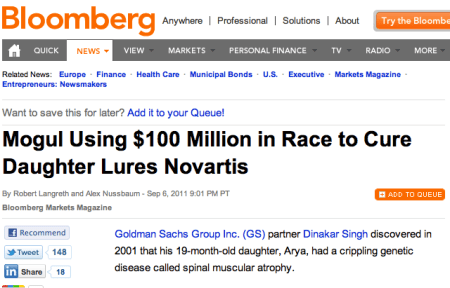
Goldman Sachs Group Inc. (GS) partner Dinakar Singh discovered in 2001 that his 19-month-old daughter, Arya, had a crippling genetic disease called spinal muscular atrophy.

The malady makes the nerve cells that control muscles gradually deteriorate. There are no treatments, let alone a cure, Bloomberg Markets magazine reports in its October issue. Worse still, while the gene causing the ailment had recently been discovered, nobody in the drug industry was doing much about it, he says.

“I was fearful and anxious that treatments would be developed, but far too late to save Arya,” says Singh, 42, who founded and runs New York hedge fund TPG-Axon Capital Management LP, which has $8.1 billion in assets. “We didn’t want to find out 25 years later that the science was really there but there isn’t a drug because nobody focused on it.”

Singh, who left Goldman in 2004, has spent almost $100 million of his own money to create and fund the Spinal Muscular Atrophy Foundation. He wants to discover and develop a drug that he hopes will help his daughter, who is one of 25,000 SMA patients in the U.S. Children with severe forms often die within a few years, while those with mild cases can live a normal life span with supportive care. Arya, 11, and starting sixth grade, uses a wheelchair.

Click HERE or on the image below to read more…


Ipierian Hires New CEO to Carry on With Stem Cells for Discovering Neurological Drugs

September 8, 2011

Ipierian Hires New CEO to Carry on With Stem Cells for Discovering Neurological Drugs

xconomy | September 7, 2011 | By Luke Timmerman

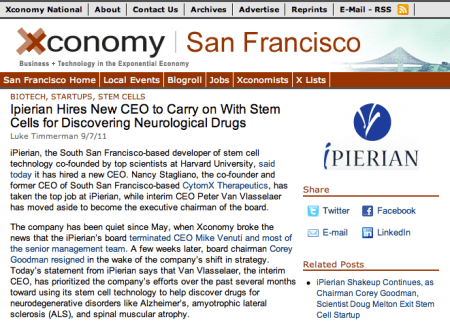
iPierian, the South San Francisco-based developer of stem cell technology co-founded by top scientists at Harvard University, said today it has hired a new CEO. Nancy Stagliano, the co-founder and former CEO of South San Francisco-based CytomX Therapeutics, has taken the top job at iPierian, while interim CEO Peter Van Vlasselaer has moved aside to become the executive chairman of the board.

The company has been quiet since May, when Xconomy broke the news that the iPierian’s board terminated CEO Mike Venuti and most of the senior management team. A few weeks later, board chairman Corey Goodman resigned in the wake of the company’s shift in strategy. Today’s statement from iPierian says that Van Vlasselaer, the interim CEO, has prioritized the company’s efforts over the past several months toward using its stem cell technology to help discover drugs for neurodegenerative disorders like Alzheimer’s, amyotrophic lateral sclerosis (ALS), and spinal muscular atrophy.

Click HERE or on the image below to read more…


From skin cells to motor neurons

August 28, 2011

From skin cells to motor neurons

Harvard Gazette | August 26, 2011

A team of Harvard stem cell researchers has succeeded in reprogramming adult mouse skin cells directly into the type of motor neurons damaged in amyotrophic lateral sclerosis (ALS), best known as Lou Gehrig’s disease, and spinal muscular atrophy (SMA). These new cells, which researchers are calling induced motor neurons (iMNs), can be used to study the development of the paralyzing diseases and to develop treatments for them.

Producing motor neurons this way is much less labor intensive than having to go through the process of creating induced pluripotent stem cells (iPSC, iPS cells), and is so much faster than the iPS method that it potentially could reduce by a year the time it eventually takes to produce treatments for ALS and SMA, said Kevin Eggan, leader of the Harvard team.

Importantly, the direct reprograming does not involve the use of any factors known to trigger cancer or any other disease states, and the factors in fact make the fibroblasts, the connective tissue cells that make and secrete collagen proteins, stop dividing.

The work by Eggan, a member of the Harvard Stem Cell Institute principal faculty and an associate professor in Harvard’s Department of Stem Cell and Regenerative Biology (SCRB), and his colleagues builds on and advances work by SCRB co-chair and Professor Doug Melton, who pioneered direct cellular reprogramming, and Marius Wernig of Stanford, who used direct reprogramming to produce generalized neurons.

In a paper given “Immediate Early Publication” online by Cell Stem Cell, the Eggan team reports that the cells they are calling iMNs appear to be fully functional. “One of the most important things we’ve done is show that when you put them into the embryo they function normally like motor neurons,” Eggan said in an interview. “They move to the right place and function on their own.”

Click HERE or on the image below to read more…


SMA: Wider ‘Window of Opportunity’ for Treatment?

August 8, 2011

SMA: Wider ‘Window of Opportunity’ for Treatment?

Quest | August 4, 2011 | By Margaret Wahl

The “window of opportunity” for treating infants at risk of developing spinal muscular atrophy (SMA) may not be as narrow as some experts have feared, new experiments in mice suggest.

MDA research grantee Umrao Monani at Columbia University Medical Center in New York coordinated the scientific team, which published its results Aug. 1, 2011, in the Journal of Clinical Investigation. (See Postsymptomatic restoration of SMN rescues the disease phenotype in a mouse model of severe spinal muscular atrophy.)

Monani described the “window of opportunity” as “the period between the birth of the child and the last point in time during which the motor unit [nerve cell and the muscle fibers it activates] can be rescued.”

This window may be “open” for a few weeks or a few months after birth, and may extend into the period when the child begins to show SMA symptoms, Monani said. “I suspect that if the patient can be treated during this period, he or she will benefit greatly.”

This finding, if confirmed in humans, further bolsters the case for newborn screening of infants for SMA. It also is good news for the potential use of several treatments for SMA currently in development.

Click HERE or on the image below to read more…


Induced Stem Cells Promise ‘A Whole New Way To Do Medicine’

August 8, 2011

Induced Stem Cells Promise ‘A Whole New Way To Do Medicine’

The Jewish Daily Forward | August 8, 2011 | By Ariel Bleicher

In Petri dishes inside Dr. Lorenz Studer’s lab, translucent clumps of human cells multiply in nutrient baths the color of red Kool-Aid. Under a microscope, the cells look round and gelatinous, like mounds of miniature eyeballs.

“You can’t tell by looking at them, but there’s something wrong in the genetic code,” said Studer, a professor of developmental biology at the Memorial Sloan-Kettering Cancer Center in New York.

Click HERE or on the image below to read more…


Systemic Gene Delivery in Large Species for Targeting Spinal Cord, Brain, and Peripheral Tissues for Pediatric Disorders

August 2, 2011

Systemic Gene Delivery in Large Species for Targeting Spinal Cord, Brain, and Peripheral Tissues for Pediatric Disorders

Journal of Molecular Therapy | 2011

Adeno-associated virus type 9 (AAV9) is a powerful tool for delivering genes throughout the central nervous system (CNS) following intravenous injection. Preclinical results in pediatric models of spinal muscular atrophy (SMA) and lysosomal storage disorders provide a compelling case for advancing AAV9 to the clinic. An important translational step is to demonstrate efficient CNS targeting in large animals at various ages. In the present study, we tested systemically injected AAV9 in cynomolgus macaques, administered at birth through 3 years of age for targeting CNS and peripheral tissues. We show that AAV9 was efficient at crossing the blood–brain barrier (BBB) at all time points investigated. Transgene expression was detected primarily in glial cells throughout the brain, dorsal root ganglia neurons and motor neurons within the spinal cord, providing confidence for translation to SMA patients. Systemic injection also efficiently targeted skeletal muscle and peripheral organs. To specifically target the CNS, we explored AAV9 delivery to cerebrospinal fluid (CSF). CSF injection efficiently targeted motor neurons, and restricted gene expression to the CNS, providing an alternate delivery route and potentially lower manufacturing requirements for older, larger patients. Our findings support the use of AAV9 for gene transfer to the CNS for disorders in pediatric populations.

Click HERE or on the image below to read more…


Pregnancy hormone has unprecedented, powerful effect on spinal muscular atrophy

July 25, 2011

Pregnancy hormone has unprecedented, powerful effect on spinal muscular atrophy

Press Release | July 25, 2011

‘Biggest increase anyone has seen’ in the production of essential compound for deadly childhood disease

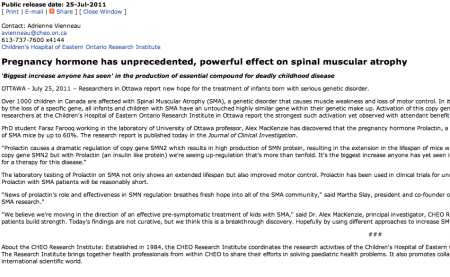
OTTAWA – July 25, 2011 – Researchers in Ottawa report new hope for the treatment of infants born with serious genetic disorder.

Over 1000 children in Canada are affected with Spinal Muscular Atrophy (SMA), a genetic disorder that causes muscle weakness and loss of motor control. In its most severe form survival of children with SMA beyond 5 years is rare. Although the disorder is caused by the loss of a specific gene, all infants and children with SMA have an untouched highly similar gene within their genetic make up. Activation of this copy gene has the potential to treat SMA, and thus has been a goal of researchers around the world. Now, researchers at the Children’s Hospital of Eastern Ontario Research Institute in Ottawa report the strongest such activation yet observed with attendant benefit on mice genetically engineered to have SMA.

PhD student Faraz Farooq working in the laboratory of University of Ottawa professor, Alex MacKenzie has discovered that the pregnancy hormone Prolactin, a Canadian discovery in itself, not only activates the copy gene but if given over time extends the lifespan of SMA mice by up to 60%. The research report is published today in the Journal of Clinical Investigation.

“Prolactin causes a dramatic regulation of copy gene SMN2 which results in high production of SMN protein, resulting in the extension in the lifespan of mice with SMA,” said Mr. Faraz Farooq. “Labs around the world have been trying to produce more protein from copy gene SMN2 but with Prolactin (an insulin like protein) we’re seeing up-regulation that’s more than tenfold. It’s the biggest increase anyone has yet seen in the SMA Field with any potential therapeutic compound. This represents a significant advance in search for a therapy for this disease.”

The laboratory testing of Prolactin on SMA not only shows an extended lifespan but also improved motor control. Prolactin has been used in clinical trials for unrelated studies, so it is expected that the path between pre-clinical validation and actual clinic trials of Prolactin with SMA patients will be reasonably short.

“News of prolactin’s role and effectiveness in SMN regulation breathes fresh hope into all of the SMA community,” said Martha Slay, president and co-founder of FightSMA. “FightSMA congratulates Dr. MacKenzie and his colleagues on this exciting breakthrough in SMA research.”

“We believe we’re moving in the direction of an effective pre-symptomatic treatment of kids with SMA,” said Dr. Alex MacKenzie, principal investigator, CHEO Research Institute. “We want to somehow stop the progress of this disorder in its tracks, and let our tiniest patients build strength. Today’s findings are not curative, but we think this is a breakthrough discovery. Hopefully by using different approaches to increase SMN protein we can develop a combination therapy for the treatment of SMA.”

###

About the CHEO Research Institute: Established in 1984, the CHEO Research Institute coordinates the research activities of the Children’s Hospital of Eastern Ontario (CHEO) and is one of the institutes associated with the University of Ottawa Teaching Hospitals. The Research Institute brings together health professionals from within CHEO to share their efforts in solving paediatric health problems. It also promotes collaborative research outside the hospital with partners from the immediate community, industry and the international scientific world.

Click HERE or on the image below to read the press release…


Families of SMA Awards $3 Million in New Spinal Muscular Atrophy Research Funding

July 21, 2011

Families of SMA Awards $3 Million in New Spinal Muscular Atrophy Research Funding

FSMA (Press Release) | July 19, 2011

Families of Spinal Muscular Atrophy (FSMA) is dedicated to creating a treatment and cure for Spinal Muscular Atrophy (SMA) by funding and advancing a comprehensive research program.  The new funding awards will be allocated into three distinct research areas: 1)Basic Research to understand the disease and provide seed ideas for drug making, 2)Drug Discovery to develop new SMA therapies, and 3)Clinical Research to provide the means to test new drugs effectively.

Click HERE or on the image below to read more…


Five Strategies for Treating Neuromuscular Disease

July 14, 2011

Five Strategies for Treating Neuromuscular Disease

Quest (MDA) | July 2011 | By Amy Labbe

Article Highlights:

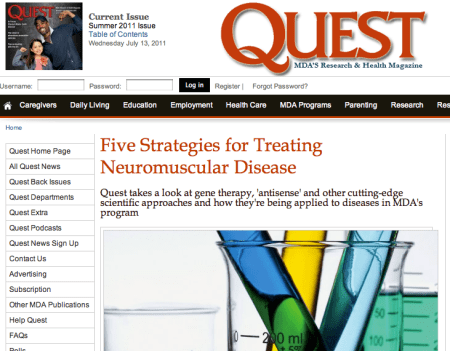
  • This article describes five leading therapeutic strategies currently being tried in neuromuscular disease research: antisense oligonucleotides, stem cells, small molecules, protein therapy and gene therapy.
  • These strategies are relevant in ALS, Becker MD, centronuclear myopathies/myotubular myopathy, Charcot-Marie-Tooth disease, congenital MD, Dejerine-Sottas disease, distal MD (Miyoshi myopathy), Duchenne MD, facioscapulohumeral MD, Friedreich’s ataxia, limb-girdle MD, myotonic MD and spinal muscular atrophy.
  • The strategies were the focus of an MDA scientific conference in March 2011 that was designed to help advance these strategies from “microscope to marketplace.”
Click HERE or on the image below to read more…