One Family’s New Normal [Video]

April 19, 2012

One Family’s New Normal [Video]

Columbus Parent | By Jane Hawes

Vodpod videos no longer available.

It’s called Spinal Muscular Atrophy Type 1 and it has become the “new normal” for the Kingsley family.

Scott and Allison Kingsley’s youngest son Brett was diagnosed with SMA-1, a disease that affects voluntary muscle movement, when he was 7 months old. He just turned 6 in March and continues to beat the odds, thanks to a family-based system of care and what his mother calls their “circle of hope.”

It’s a circle that starts with Brett or “Prince Brett,” as Nationwide Children’s Hospital social worker Lori McCullough and other staff members there have dubbed him. He’s a blond-haired boy with dark eyes that move constantly, taking in everything around him, and elegantly long fingers that dance across the controls of the DynaVox, a speech-generating device, that talks for him.

The next ring of the circle is populated by his immediate family. Allison is the mom. You could call her a homemaker, but to do so you’d have to expand your definition of “home” to include most of the 614 area code. When she isn’t overseeing much of Brett’s therapies, doctors’ visits and all three of her children’s schooling in the Hilliard district, she’s giving speeches to new employees at Nationwide Children’s Hospital as part of their Family Advisory Council’s “Family as Faculty” program. And, of course, she’s also getting everyone else in the family fed, clothed and off to school, work or church each day.

Click HERE or on the image below to read more…


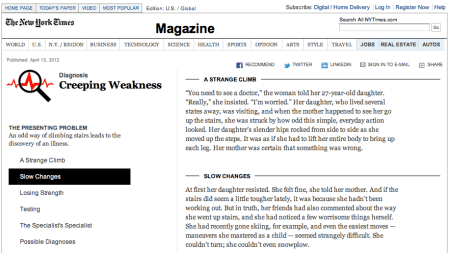
Diagnosis: Creeping Weakness

April 15, 2012

Creeping Weakness

New York Times Magazine | April 13, 2012

“You need to see a doctor,” the woman told her 27-year-old daughter. “Really,” she insisted. “I’m worried.” Her daughter, who lived several states away, was visiting, and when the mother happened to see her go up the stairs, she was struck by how odd this simple, everyday action looked. Her daughter’s slender hips rocked from side to side as she moved up the steps. It was as if she had to lift her entire body to bring up each leg. Her mother was certain that something was wrong.

Click HERE or on the image below to read more…


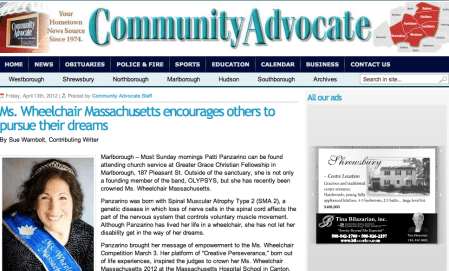
Ms. Wheelchair Massachusetts encourages others to pursue their dreams

April 15, 2012

Ms. Wheelchair Massachusetts encourages others to pursue their dreams

Community Advocate | April 13, 2012 | By Sue Wamboldt

Marlborough – Most Sunday mornings Patti Panzarino can be found attending church service at Greater Grace Christian Fellowship in Marlborough, 187 Pleasant St. Outside of the sanctuary, she is not only a founding member of the band, OLYPSYS, but she has recently been crowned Ms. Wheelchair Massachusetts.

Panzarino was born with Spinal Muscular Atrophy Type 2 (SMA 2), a genetic disease in which loss of nerve cells in the spinal cord affects the part of the nervous system that controls voluntary muscle movement. Although Panzarino has lived her life in a wheelchair, she has not let her disability get in the way of her dreams.

Panzarino brought her message of empowerment to the Ms. Wheelchair Competition March 3. Her platform of “Creative Perseverance,” born out of life experiences, inspired the judges to crown her Ms. Wheelchair Massachusetts 2012 at the Massachusetts Hospital School in Canton. The mission of the Ms. Wheelchair America Program, and the individual state programs, is to “provide an opportunity for women of achievement who utilize wheelchairs to successfully educate and advocate for individuals with disabilities,” according to the organization’s website http://www.mswheelchairmass.org.

“The platform for my year as Ms. Wheelchair Massachusetts is ‘Creative Perseverance.’ This has actually been the theme of my whole life,” Panzarino said. “I learned to self-advocate from my older sister who mentored me at a very young age. The more that people with disabilities push through obstacles and participate in life, the more people will see us and our acceptance and encouragement to participate increases. It becomes an upward spiral.”

Click HERE or on the image below to read more…


Disabled but determined: Winton filmmaker has Hollywood dreams

April 15, 2012

Disabled but determined: Winton filmmaker has Hollywood dreams

Merced Sun-Star | April 13, 2012 | By Doane Yawger

WINTON — Don’t tell Aaron Schindler something is impossible. That will make him even more determined to make it happen.

The 31-year-old Winton resident has muscular dystrophy and spinal muscular atrophy, which make him wheelchair-bound and severely limit his mobility. Despite these setbacks, he intends to produce a full-length animated feature film that could hit movie screens in about three years.

“The quote I live by is, ‘Nothing is impossible,’ ” he said. “If you take the impossible and break it into little tasks, the impossible becomes possible. I’m a pretty easygoing person and let stuff roll off my shoulders and don’t let anything bug me too much.”

Click HERE or on the image below to read more…


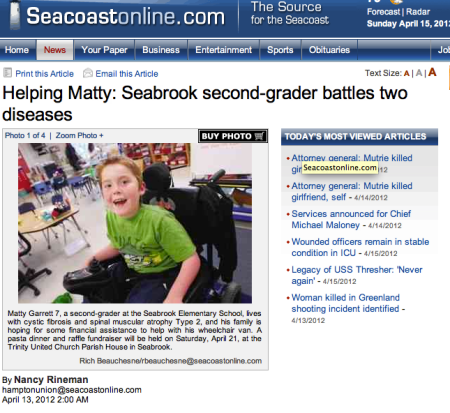
Helping Matty: Seabrook second-grader battles two diseases

April 15, 2012

Helping Matty: Seabrook second-grader battles two diseases

Seacoastonline.com | April 13, 2012 | By Nancy Rineman

SEABROOK — Seven-and-a-half-year-old Matty Garrett is a master of animal facts.

The Seabrook Elementary School second-grader can tell you all about natural habitats and what animals eat, and his spelling is impeccable, thanks to the volumes of books he reads. He also is a fan of National Geographic’s “America the Wild” and Animal Planet.

Bright and beaming with enthusiasm, Matty shares stories and banter with classmates in teacher Cathy MacDonald’s classroom, working through each school day as a child with cystic fibrosis and spinal muscular atrophy Type 2.

Matty was diagnosed with both diseases at six months old. The chances of one person being diagnosed with both diseases are one in three million, according to Matty’s family.

Click HERE or on the image below to read more…


Abnormally low level of SMN protein linked to movement problems in spinal muscular atrophy

April 15, 2012

Abnormally low level of SMN protein linked to movement problems in spinal muscular atrophy

News-Medical.net | April 12, 2012

An abnormally low level of a protein in certain nerve cells is linked to movement problems that characterize the deadly childhood disorder spinal muscular atrophy, new research in animals suggests.

Spinal muscular atrophy, or SMA, is caused when a child’s motor neurons – nerve cells that send signals from the spinal cord to muscles – produce insufficient amounts of what is called survival motor neuron protein, or SMN. This causes motor neurons to die, leading to muscle weakness and the inability to move.

Though previous research has established the disease’s genetic link to SMN in motor neurons, scientists haven’t yet uncovered how this lack of SMN does so much damage. Some children with the most severe form of the disease die before age 2.

A research team led by Ohio State University scientists showed in zebrafish that when SMN is missing – in cells throughout the body as well as in motor neurons specifically – levels of a protein called plastin 3 also decrease.

When the researchers added plastin 3 back to motor neurons in zebrafish that were genetically altered so they couldn’t produce SMN, the zebrafish regained most of their swimming abilities – movement that had been severely limited by their reduced SMN. These findings tied the presence of plastin 3 – alone, without SMN – to the recovery of lost movement.

Click HERE or on the image below to read more…


New approach for treating genetic muscle wasting disease shows promise in mice

March 6, 2012

New approach for treating genetic muscle wasting disease shows promise in mice

HealthCanal.com | March 6, 2012

OTTAWA — Scientists from the Ottawa Hospital Research Institute (OHRI) and the University of Ottawa (uOttawa) have discovered that a drug called fasudil can extend the average lifespan of mice with Spinal muscular atrophy (SMA) from 30.5 days to more than 300 days.

The study is published today in BioMed Central’s open access journal BMC Medicine, by Dr. Rashmi Kothary, his graduate student Melissa Bowerman and others.

SMA is the leading inherited cause of death in infants and toddlers, affecting approximately 25,000 people in Canada and the United States. Scientists have known for many years that this disease is caused by inherited mutations in a gene called survival motor neuron 1 (SMN1). Most early attempts at developing treatments for SMA focused on replacing this gene, however, Dr. Kothary’s group has focused on understanding and targeting the physiological defects present in certain nerve cells with SMA. These cells have a weakened internal scaffold, which hinders their ability to connect with muscle cells and contributes to the severe muscle weakness associated with SMA.

Two years ago, Dr. Kothary and his team showed that a laboratory compound called Y-27632, which targets an enzyme that is involved in maintaining the cellular scaffold, could greatly increase lifespan in a certain mouse model of SMA. In this new study, they tested a compound called fasudil, which is similar to Y-27632, but has the advantage that it has already been approved for human clinical trials for other conditions, meaning that it could possibly be re-targeted to use in clinical trials for SMA more quickly than a completely new drug.

The Kothary group found that fasudil-treated SMA mice survived for an average of more than 300 days, compared to just 30.5 days for untreated SMA mice. However, the average lifespan of fasudil-treated SMA mice was still only about half as long as that of normal mice. Fasudil-treated SMA mice also had larger muscle fibres than the untreated SMA mice, and they behaved more normally with respect to grooming and other regular activities. However, they did not perform any better in strength and balance tests and they still had low numbers of motor neurons, which is typical for SMA.

Click HERE or on the image below to read more…


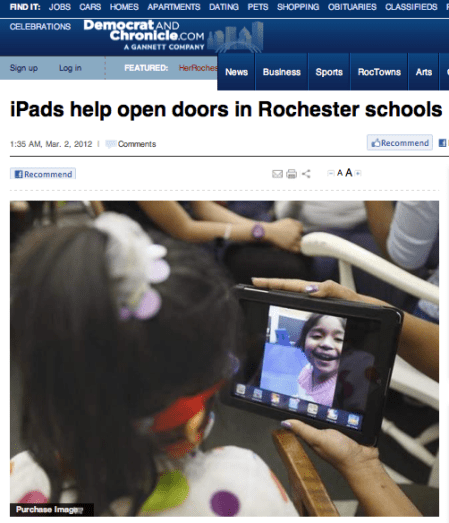
iPads help open doors in Rochester schools

March 6, 2012

iPads help open doors in Rochester schools

Democrat And Chronicle | March 2, 2012 | By Tiffany Lankes

For most of her years in school, 10-year-old Haydee Lopez’s ability to participate in class was extremely limited.

The School 29 student has spinal muscular atrophy, which is slowly eroding her physical strength and has confined her to a wheelchair. The muscles in her hands are so weak that Haydee cannot hold a pencil. Her reach extends just a few inches from her body, so she cannot use a keyboard. While her body lacks physical strength, her mind is sharp, and helping her express herself is a constant challenge for her teachers.

But despite her limitations, this school year Haydee wrote her first report. Using an iPad, she was able to type out full sentences to demonstrate what she learned about dolphins.

“I think this is the first time she ever saw something she did from beginning to end,” said her teacher, Becky Robbins.

Haydee’s story highlights the success some city schools are seeing as they use the latest technology trend to help their special education students.

While other schools and districts have taken a broader approach to buying iPads — some putting them in the hands of every student at every grade level — Rochester is taking a more focused approach, targeting students in the primary grades and those with disabilities.

Click HERE or on the image below to read more…


theGSF Launches First-Of-Its-Kind, Free iPad Communication App For Those With Limited Movement

February 27, 2012

theGSF Launches First-Of-Its-Kind, Free iPad Communication App For Those With Limited Movement

Press Release | February 27, 2012

Santa Barbara, CA — February 27, 2012 — The Gwendolyn Strong Foundation (theGSF), a Santa Barbara-based nonprofit launched “Say Hi! AAC” (Say Hi!), a first-of-its-kind augmentative and alternative communication (AAC) iPad app with the aim of opening the world of communication for those with severe physical disabilities, limited movement, and/or challenged dexterity. The unique app allows the user to communicate wants, needs, emotions, etc. via the iPad without ever physically touching the iPad touchscreen. Say Hi! is available for free in the Apple App Store.

Simple by design, the Say Hi! iPad communication app is completely customizable to suit the specific needs of the user. Once installed on the iPad, the user can create communication pages with boxes of words, phrases, images, and recorded sounds. Say Hi! requires the use of an iPad, which displays what the user would like to communicate, and two additional iPod Touch or iPhone devices. The two additional devices wirelessly connect to the iPad with one iPod/iPhone device acting as the “mover” and the other as the “selector.” The “mover” allows the user to move between customized boxes on the iPad communication app and the “selector” allows the user to select the desired box and “say” the associated word or phrase. Utilizing these connected devices in unison, the user can navigate the Say Hi! iPad communication app with almost no physical movement. Nothing like this currently exists.

Click HERE or on the image below to read more…


Child motor neurone disease treatment clue

February 27, 2012

Child motor neurone disease treatment clue

BBC News | February 26, 2012

Scottish research has shown it could be possible to reverse the muscle damage seen in children with a form of motor neurone disease.

Spinal muscular atrophy (SMA) – ‘floppy baby syndrome’ – is the leading genetic cause of death in children.

It affects one in 6,000 births, but 50% of those with the most severe form die before the age of two.

The University of Edinburgh mouse study suggests a drug could boost levels of a protein and so reverse muscle damage.

Click HERE or on the image below to read more…