December 22, 2011
Single Administration of Antisense Oligomer Delivered to the CNS Rescues a Severe Mouse Model of Spinal Muscular Atrophy
FSMA News | December 22, 2011
The Burghes laboratory at Ohio State University publishes a paper in Human Molecular Genetics showing a single dose of an antisense oligomer (ASO) can greatly benefit survival, weight gain, and motor function in severe mouse model of SMA.
In this study, the authors delivered a bolus ICV injection of anti-sense oligonucleotide (ASO) of morpholino chemistry to alter SMN2 splicing and increase SMN levels. Treated SMA mice had improvement in weight gain, motor activity, and increased survival from 15 days to over 100 days. Delayed CNS delivery (P4) had an intermediate advantage, evidence that earlier CNS treatment yields more robust effects, while delayed peripheral delivery after blood-brain-barrier maturation had only modest increased survival. This suggests that CNS delivery of SMN is key to therapeutic benefit in this SMA mouse model.
Click HERE or on the image below to read more…

 Leave a Comment » |
  FSMA, Ohio, Research, United States | Tagged: FSMA, ohio, research, united states |
  Permalink
 Posted by stronwi
December 22, 2011
Mum strives for awareness of Spinal Muscular Atrophy
GetReading.co.uk | December 21, 2011 | By Laura McCardle
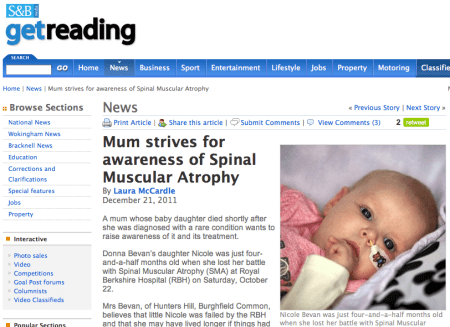
A mum whose baby daughter died shortly after she was diagnosed with a rare condition wants to raise awareness of it and its treatment.
Donna Bevan’s daughter Nicole was just four-and-a-half months old when she lost her battle with Spinal Muscular Atrophy (SMA) at Royal Berkshire Hospital (RBH) on Saturday, October 22.
Mrs Bevan, of Hunters Hill, Burghfield Common, believes that little Nicole was failed by the RBH and that she may have lived longer if things had been done differently.
Neurologists diagnosed Nicole with SMA on Friday, September 23, and Mrs Bevan felt her husband Nick and she were told very little about the condition except that their daughter “would have 12 months give or take”.
Click HERE or on the image below to read more…
Leave a Comment » | Advocacy, Awareness, Carrier Screening, United Kingdom | Tagged: advocacy, awareness, carrier screening, united kingdom | Permalink
Posted by stronwi
December 22, 2011
Fulton man’s memoir demonstrates the power of a fighting spirit
Syracuse.com | December 19, 2011 | By Sara Tracey
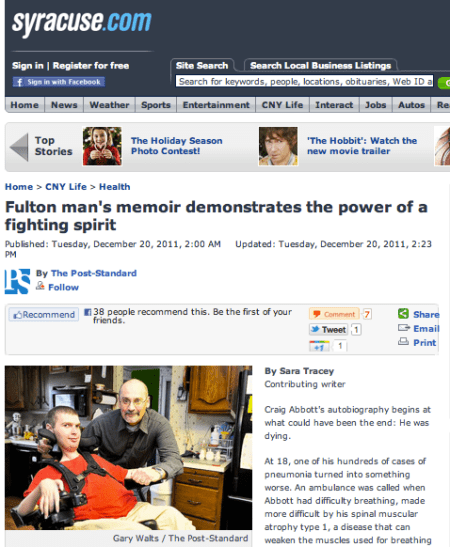
Craig Abbott’s autobiography begins at what could have been the end: He was dying.
At 18, one of his hundreds of cases of pneumonia turned into something worse. An ambulance was called when Abbott had difficulty breathing, made more difficult by his spinal muscular atrophy type 1, a disease that can weaken the muscles used for breathing and coughing.
On the drive to the hospital, the cough assist machine in the ambulance that would clear his lungs to improve his breathing wasn’t working. He passed out while the ambulance staff used a manual respirator to breathe for him. He came back to consciousness 13 hours later, hooked up to another breathing machine.
Abbott, now 23, of Fulton, said he opened his book “Classified Terminally Ill: A Young Man’s Story of Beating the Odds,” with this incident because of his fighting spirit. It’s a resilience that friends say Abbott has possessed his whole life.
Click HERE or on the image below to read more…
Leave a Comment » | Inspiration, New York, United States | Tagged: inspiration, new york, united states | Permalink
Posted by stronwi
December 19, 2011
Isis Initiates Phase 1 Clinical Study of ISIS-SMNRx in Patients With Spinal Muscular Atrophy
Press Release | December 19, 2011
CARLSBAD, Calif., Dec. 19, 2011 /PRNewswire/ — Isis Pharmaceuticals, Inc. (NASDAQ: ISIS) announced today that it has initiated a Phase 1 study of ISIS-SMNRx in patients with spinal muscular atrophy (SMA). SMA is a severe motor-neuron disease that is the leading genetic cause of infant mortality. Isis is developing ISIS-SMNRx as a potential treatment for all Types of SMA.
“SMA is a devastating disease that leads to the loss of motor neurons resulting in muscle weakness and respiratory failure in children. The genetic cause of this disease is well understood, but there are currently no effective disease-modifying therapies. Currently, treatment of SMA is entirely symptomatic and focuses on preserving muscle strength and lung function by physical therapy and assisted ventilation. This supportive approach has improved the natural history of SMA by extending life expectancy, but muscle weakness and atrophy are not affected. A disease-modifying drug like ISIS-SMNRx that specifically targets the cause of the disease could, for the first time, restore muscle strength and respiratory function and dramatically improve the children’s function and quality of life,” said Darryl C. De Vivo, M.D., Sidney Carter Professor of Neurology and Pediatrics and Co-Director of the Motor Neuron Center at Columbia University Medical Center.
Click HERE or on the image below to read more…
Leave a Comment » | California, Clinical Trial, FSMA, MDA, Press Release, Research, SMA Foundation, United States | Tagged: california, clinical trial, FSMA, MDA, research, sma foundation, united states | Permalink
Posted by stronwi
December 16, 2011
theGSF.org | December 15, 2011
The Gwendolyn Strong Foundation (theGSF) and FightSMA are excited to announce a $100,000 award to Dr. Monique A. Lorson and University of Missouri in support of Dr. Lorson’s research focused on developing a large animal model of Spinal Muscular Atrophy (SMA).
Currently, no large animal model of SMA exists and the goal of Dr. Lorson’s research is to develop the first ever pig based model of SMA to be used by the broad, global SMA research community and other research groups to allow them to more efficiently and effectively move promising research from the bench to bedside. In short, this is a very exciting program that has the potential to have a material, positive impact on the future of SMA research in almost every category (e.g. gene therapy, compounds, antisense oligonucleotides).
Click HERE or on the image below to read more…
1 Comment | Blog post, California, FightSMA, Gwendolyn Strong Foundation, Research, United States, Virginia | Tagged: blog post, california, fightsma, Gwendolyn Strong Foundation, research, united states, virginia | Permalink
Posted by stronwi
December 16, 2011
4-year-old needs device to help her breathe
Cincinnati.com | December 11, 2011 | By Mark Hansel
Karah Barry’s mind is as sharp as any other 4-year-old’s.
She is bright and personable, reads, participates in a preschool program and plays on a miracle league baseball team.
Karah’s body, however, prevents her from participating in a lot of other activities common to girls of her age.
She has spinal muscular atrophy type 1, commonly referred to as SMA.
Karah cannot walk, talk, sit, or swallow and she is at high risk of acute respiratory failure. She relies on an automatic cough assist machine and a technique called CPT because she has no ability to clear secretions.
“She is a prisoner in her own body,” said Danielle Barry, Karah’s mother.
Click HERE or on the image below to read more…

Leave a Comment » | Advocacy, Awareness, Health Insurance, Ohio, United States | Tagged: advocacy, awareness, health insurance, ohio, united states | Permalink
Posted by stronwi
December 9, 2011
Playground for Physically Disabled Children Scheduled for Summer Completion
Woodbury Patch | December 9, 2011 | By Zac Farber
Before Madison Claire Millington died at the age of 2 in 2004, her mother, Dana, was frustrated by Madison’s inability to enjoy any of Woodbury’s playgrounds.
Madison was born with spinal muscular atrophy—a genetic disease that destroys the nerve cells controlling voluntary muscle movement—and she was restricted to a stroller.
“We couldn’t take Madison and our other two children together to go to any of the playgrounds in Woodbury,” Dana Millington said, “because she was stuck in a special stroller and I wasn’t able to get her access to the structure.”
Shortly after Madison’s death, Dana heard about a California organization, Shane’s Inspiration, founded by parents who had lost their son to spinal muscular atrophy. The organization raised money to build playgrounds where children with physical and developmental disabilities could play alongside their “typically able” peers.
Click HERE or on the image below to read more…

1 Comment | Adapted Equipment, Fundraiser, Inspiration, Minnesota, Tribute, United States | Tagged: adapted equipment, fundraiser, inspiration, minnesota, tribute, united states | Permalink
Posted by stronwi
December 2, 2011
Hopkins Medical Magazine | Fall 2011 | By Christen Brownlee
Nothing can keep Payton Mueller down, not even the spinal muscular atrophy (SMA) that continues to take its toll on his young body. Doctors here share his optimism. Thanks to rapid advances in research and clinical care, the future for patients with SMA has never looked brighter.
Click HERE or on the image below to read more…

Leave a Comment » | Maryland, Research, United States | Tagged: maryland, research, united states | Permalink
Posted by stronwi
November 30, 2011
Roche Enters Race to Cure Genetic Disease With $490 Million Deal
Press Release | November 30, 2011 | By Robert Langreth
Roche Holding AG will pay as much as $490 million for experimental drugs from PTC Therapeutics Inc. to treat a genetic muscle-weakening disease, in a deal that sets up a race with rival Novartis AG.
The Basel, Switzerland-based drugmaker will pay closely held PTC Therapeutics $30 million up front, and another $460 million if a drug for spinal muscular atrophy achieves certain regulatory and commercial goals, the companies said today in a statement. PTC, based in South Plainfield, New Jersey, would also get royalties on sales of drugs from the collaboration.
Spinal muscular atrophy afflicts 18,000 people in the U.S. and Europe and causes progressive muscle weakness, according to the Spinal Muscular Atrophy Foundation. Kids with severe cases die within a few years, while those with mild cases can live a normal lifespan with disabilities. There are no approved medicines to treat the causes of the rare disorder, said Luca Santarelli, senior vice president of neuroscience at Roche.
“There are absolutely no therapeutic options for these children,” said Santarelli in a phone interview. “It is a frightening disease.”
Click HERE or on the image below to read more…

1 Comment | New Jersey, New York, Research, SMA Foundation, Switzerland, United States | Tagged: new jersey, new york, research, sma foundation, switzerland, united states | Permalink
Posted by stronwi
November 22, 2011
Synthetic RNA Lessens Severity of Fatal Disease
Science Daily | November 21, 2011
A team of University of Missouri researchers have found that targeting a synthetic molecule to a specific gene could help the severity of the disease Spinal Muscular Atrophy (SMA) — the leading genetic cause of infantile death in the world.
“When we introduced synthetic RNA into mice that carry the genes responsible for SMA, the disease’s severity was significantly lowered,” said Chris Lorson, researcher at the Bond Life Sciences Center and professor in the Department of Veterinary Pathobiology and the Department of Molecular Microbiology and Immunology. “The mice that receive synthetic RNA gain more weight, live longer, and had improvements in motor skills. These results are very exciting.”
Click HERE or on the image below to read more…

Leave a Comment » | Missouri, Research, United States | Tagged: missouri, research, united states | Permalink
Posted by stronwi


 SMAHeadlines.com