Beating the odds against Spinal Muscular Atrophy

February 15, 2012

Beating the odds against Spinal Muscular Atrophy

The Chronicle | February 15, 2012 | By François Lemieux

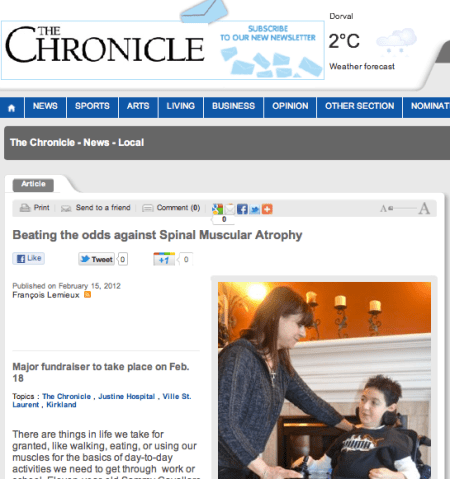
There are things in life we take for granted, like walking, eating, or using our muscles for the basics of day-to-day activities we need to get through work or school. Eleven-year-old Sammy Cavallaro doesn’t have this luxury. He has Spinal Muscular Atrophy (SMA), a motor-neuron disease that confines him to a wheelchair and impairs his muscular movements.

On Feb. 18, Sammy’s family is organizing a major fundraiser to generate awareness of the little-known disease and to raise funds for research. The event, called ‘Sammy’s Valentine Gala’, will take place at 6600 Montée de Liesse in Ville St. Laurent.

“It’s like an Italian dinner; we eat, we drink, we dance, there is a silent auction, there are raffle prizes, just a lot of fun and you give to a great cause,” said Sammy’s mother Rosa Cavallaro, last week. “Every year we do a fundraiser, around Valentine’s Day. This is our ninth one.”

Click HERE or on the image below to read more…

SMA Gene Associated with Sporadic ALS

February 15, 2012

SMA Gene Associated with Sporadic ALS

MDA/ALS NewsMagazine | February 10, 2012 | By Amy Labbe

Duplications (extra copies) of the SMN1 gene are a “major” risk factor for developing sporadic (noninherited) ALS (amyotrophic lateral sclerosis), a team of scientists based in the Netherlands and United Kingdom has reported.

The SMN1 gene also is implicated in the motor neuron disease spinal muscular atrophy (SMA). Deletions or mutations in the SMN1 gene (SMN stands for “survival of motor neurons”) lead to a deficiency of SMN protein and are the underlying cause of SMA.

ALS and SMA both are diseases in which muscle-controlling nerve cells called motor neurons degenerate and die, leading to profound muscle weakness and, eventually, paralysis.

The research team, including corresponding author L.H. van den Berg at the University Medical Center Utrecht in Utrecht, the Netherlands, described its findings online Feb. 8, 2012, in Neurology. (See SMN1 gene duplications are associated with sporadic ALS.)

Further research is needed to determine how SMN1 gene duplications raise the risk of developing ALS, and any potential for SMN1-based ALS biological markers (biomarkers) or therapies.

Click HERE or on the image below to read more…


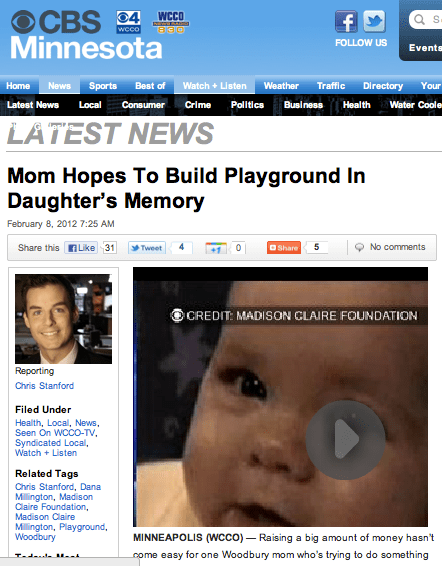
Mom Hopes To Build Playground In Daughter’s Memory

February 8, 2012

Mom Hopes To Build Playground In Daughter’s Memory

CBS Minnesota | February 8, 2012

Raising a big amount of money hasn’t come easy for one Woodbury mom who’s trying to do something special in honor of the daughter she lost.

Madison Claire Millington died August 2004 when she was only 2 years old. When she was diagnosed with Spinal Muscular Atrophy, her mom, Dana Millington, was told that Madison Claire only had one year to live.

Almost eight years later, Millington calls her youngest daughter Emerson a miracle. Emerson had a one in four chance of inheriting the same deadly muscular disease that took her sister, Madison Claire.

To ensure that Emerson wasn’t born with Spinal Muscular Atrophy, Millington and her husband used In Vitro Fertilization and a process which tests the eggs for genetic abnormalities before they’re fertilized.

The time spent with Emerson is special considering the difficulties of parenting a child with SMA.

“(Madison) had her special stroller. We had oxygen tanks we had to take with,” said Millington. “Even going to the park, we couldn’t go through the sand and rocks for me to also be with my other two children.”

It was that specific challenge that compelled Millington to help others. After Madison died, she made it a priority to raise enough money for a playground that every kid could use, in honor of her daughter.

Click HERE or on the image below to read more…


Florence teens grant wish of 5-year-old with Spinal Muscular Atrophy

February 7, 2012

Florence teens grant wish of 5-year-old with Spinal Muscular Atrophy

SCNow.com | February 3, 2012 | By Patricia Burkett

FLORENCE- A legacy of giving came full circle in Florence Wednesday, as high school students came together to honor the legacy of a former assistant principal while making one child’s dreams come true.

Members of West Florence High School’s student government began a fundraising campaign on Dec. 1, to collect money to grant the wish of five-year-old Grace Dixon.

Representatives from the Make-A-Wish Foundation asked officials at the school if they would like to help grant the wish of Dixon, who suffers from Spinal Muscular Atrophy.

The condition causes progressive muscle degeneration and weakness.

Grace’s mother, Robin, said she was very surprised when she found out that her child’s wish would be granted through the generosity of other young people.

“It was very heartwarming and amazing,” Robin Dixon said.

Click HERE or on the image below to read more…


Ella’s Story: ‘I’m Not Here to Save Her. I’m Here to Take Care of Her’

February 2, 2012

Ella’s Story: ‘I’m Not Here to Save Her. I’m Here to Take Care of Her’

ElmhurstPatch | February 2, 2012 | By Karen Chadra

Ella Casten is a smart, inquisitive little girl with a smile that will melt your heart.

In most ways, she is a typical 1 1/2-year-old. She loves her dog, her toys, and her brother and sister, Henry and Ava. She speaks in cute toddler language and wants to do things all by herself.

But she can’t. Her muscles won’t let her. Ella has a rare, genetic neuromuscular disease called spinal muscular atrophy, for which there is no treatment or cure. Her motor neurons are dying, causing her to lose muscle function. She first lost the use of her legs, and now she has trouble reaching and lifting even small toys.

Ella was born on June 10, 2010. She started out seemingly healthy, hitting all the normal developmental milestones in her first year. She began to stand and take a few steps.

Just five months ago, all that changed.

Her parents, Lincoln Elementary School teacher Michael Casten, and Lindsay Casten, a former Lincoln teacher, began to try to unravel the mystery with the help of pediatricians and therapies. An Internet search revealed what they had hoped was not the answer.

“I’ll never forget that night,” Lindsay said. “I Googled hypotonia (poor muscle tone) and hand tremors and one of the things that came up was SMA. Of all the possibilities we had been told, we didn’t want it to be that.”

Click HERE or on the image below to read more…


MDA Commits $12 Million to Neuromuscular Disease Research

February 1, 2012

MDA Commits $12 Million to Neuromuscular Disease Research

Quest Magazine | February 1, 2012 | By Amy Labbe

The Muscular Dystrophy Association has awarded 38 new grants totaling more than $12 million to fund research projects focused on its continuing mission to uncover the causes of, and develop therapies for, the more than 40 neuromuscular diseases in its program.

MDA’s Board of Directors reviewed and approved the new grants based on recommendations from the Association’s Scientific and Medical Advisory Committees, and the grants took effect Feb. 1.

Recent scientific advances have led to increased funding in promising new areas of research, including development of therapies that not only slow and stop neuromuscular diseases, but also reverse damage caused by the disease processes. The goal in many of the projects is to develop new therapies or to make current therapies better.

“It is exciting that several of these new basic research projects are focused on the development of new therapeutic strategies,” noted MDA Vice President of Research Sanjay Bidichandani.

Click HERE or on the image below to read more…


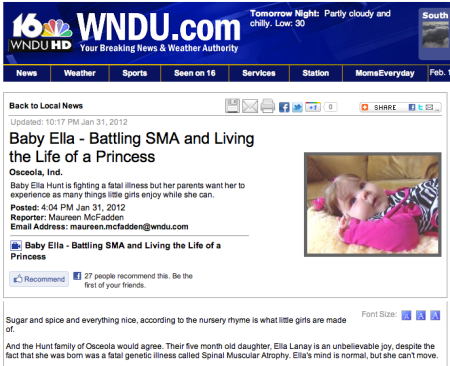
Baby Ella – Battling SMA and Living the Life of a Princess

February 1, 2012

Baby Ella – Battling SMA and Living the Life of a Princess

WNDU (NBC) | February 1, 2012 | By Maureen McFadden

Sugar and spice and everything nice, according to the nursery rhyme is what little girls are made of.

And the Hunt family of Osceola would agree. Their five month old daughter, Ella Lanay is an unbelievable joy, despite the fact that she was born was a fatal genetic illness called Spinal Muscular Atrophy. Ella’s mind is normal, but she can’t move.

Like many parents, they want their first daughter to experience the joys girls do growing up, but they have to do it in the time they have.

Ella may be one of the youngest girls with a Facebook page, but that’s where her mom Erica and dad, Dan and brothers Noah and Carter post their dream list for Ella.

Erica suspected something was wrong with Ella by the time she was about ten weeks old. She just wasn’t meeting the milestones parents are used to.

Doctors first suspected a muscle condition but a trip to Riley Children’s hospital on December 20th gave them a diagnosis.

Research is ongoing, but most children with SMA don’t live past two, according to Erica. “It is a fatal disease so it will take her life. We just don’t know when.”

Click HERE or on the image below to read more…


Precious moments with our baby boy

January 30, 2012

Precious moments with our baby boy

Yorkshire Post | January 26, 2012

Watching your baby die from an incurable condition must be the worst thing for any parent. Catherine Scott spoke to one mother who has done just that.

Lucas Hannigan was a perfect baby. Unlike his big brother James he was an easy going baby who slept well. He passed all his newborn health checks and soon his parents Jenny and Steve were able to take their new baby home to Bingley.

But at his eight-week check the GP was puzzled – Lucas was thriving but he was very weak – he called it Hypotonia – and also noticed that his Moro (or startle reflex) was absent, although it had been their when he was born.

The GP wasn’t overly worried but he wanted them to see a paediatrician as he had never seen this before.

The family was referred to a neuromuscular specialist at the Leeds General Infirmary (LGI) .Eventually after a DNA test, Lucus was diagnosed with Spinal Muscular Atrophy (SMA), but by then the family had already pretty much diagnosed the condition themselves.

“The hospital wouldn’t tell us anything, so I put Lucas’s symptoms into the internet and almost immediately came across the Jennifer’s Trust website and couldn’t believe what I was reading.

Click HERE or on the image below to read more…


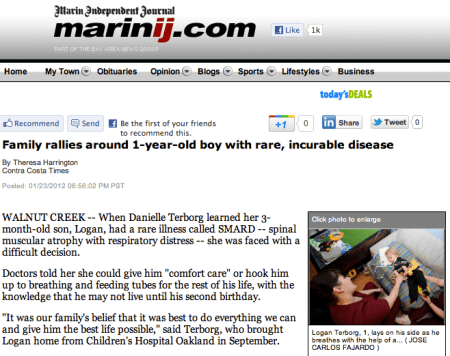
Family rallies around 1-year-old boy with rare, incurable disease

January 26, 2012

Family rallies around 1-year-old boy with rare, incurable disease

Contra Costa Times | January 23, 2012 | By Theresa Harrington

When Danielle Terborg learned her 3-month-old son, Logan, had a rare illness called SMARD — spinal muscular atrophy with respiratory distress — she was faced with a difficult decision.

Doctors told her she could give him “comfort care” or hook him up to breathing and feeding tubes for the rest of his life, with the knowledge that he may not live until his second birthday.

“It was our family’s belief that it was best to do everything we can and give him the best life possible,” said Terborg, who brought Logan home from Children’s Hospital Oakland in September.

Before that, she and other family members spent hours by Logan’s side, playing with the blue-eyed, dimple-cheeked boy whose smile fills the room, even if he has a ventilator tube that keeps him alive. His grandmother, Peggy Thomas, and his mother alternate caring for him, along with in-home nurses. In the meantime, they have also researched his disease, finding one boy with it has lived to age 20.

Dr. Gregory Cox, a researcher at the Jackson Laboratory in Bar Harbor, Maine, is one of the few scientists in the world studying the disease and trying to find a cure.

It is so rare, he said, that statistics about how many children have it are not available, especially since so many victims die very young.

Click HERE or on the image below to read more…


FightSMA Names New Executive Director; Relocates Headquarters to Nation’s Capital

January 23, 2012

FightSMA Names New Executive Director; Relocates Headquarters to Nation’s Capital

Press Release | January 18, 2012

FightSMA, an international nonprofit organization created to strategically accelerate the search for a treatment and cure for spinal muscular atrophy (SMA), has named Ron Imbach as its new Executive Director, effective Dec. 1, 2011.

Ron Imbach is replacing the current CEO and founder of FightSMA, Martha Slay, who guided the organization from its inception in 1991 until the present. Under Martha’s leadership, FightSMA has grown from an initial crusade to bring higher levels of awareness and understanding of spinal muscular atrophy (SMA) to the public to a leading advocate and research-centered organization focusing on the treatment and cure of the disease and support for the families of children with SMA.

“For the past 20 years, Martha Slay has led FightSMA with great passion, intelligence, and dedication; the SMA community owes her a great deal of gratitude for her accomplishments,” said FightSMA Chair Mike Calise. “She has been a great inspiration to us all personally and professionally.”

Click HERE or on the image below to read more…