Results From CARNI-VAL Clinical Trial Published: A Twelve Month Prospective, Open-label Trial of VPA and L-carnitine in Ambulatory Children with SMA

July 11, 2011

Results From CARNI-VAL Clinical Trial Published: A Twelve Month Prospective, Open-label Trial of VPA and L-carnitine in Ambulatory Children with Spinal Muscular Atrophy

FSMA | July 6, 2011

The second set of results from the Families of Spinal Muscular Atrophy funded CARNI-VAL clinical trial in ambulatory children published in PLoS ONE. The trial was completed by the Project Cure SMA Clinical Trial Network. The trial was registered at clinicaltrials.gov with identifier: NCT00227266.

Multiple lines of evidence, including treatment of patient-derived cell lines, animal models and open-label pilot human trials, have suggested that valproic acid (VPA) might have a therapeutic benefit in patients with spinal muscular atrophy. The SMA CARNIVAL TRIAL was a trial designed to evaluate the effectiveness of combined oral VPA and l-carnitine in two different groups of children with SMA. Group 1 of this trial targeted non-ambulatory SMA children 2-8 years of age, randomized to receive placebo or treatment for the first six months, then active treatment for an additional six months (Please see group 1 results in an earlier article in this issue of Compass). Group two of this study was a twelve month open-label trial of VPA and L-carnitine in ambulatory children with SMA. Group two of the study involved an ambulatory group of 33 genetically proven SMA “standers and walkers” (type 3), between the ages 3-17 years.

Participants underwent two initial baseline assessments of functional over a 4-6 week period and then were placed on VPA and L-carnitine for 12 months. Functional assessments were performed at baseline, 3, 6 and 12 months. Several primary functional assessments (outcomes / trial endpoints) were used, including safety, adverse event data, and efficacy. Efficacy (potential benefit) was measured by change in motor function at 6 and 12 months using the Modified Hammersmith Functional Motor Scale Extend (MHFMS-Extend), timed tests of gross motor function, and a fine motor module. Secondary outcome measures were tested at 6 and 12 month. These included maximum ulnar compound muscle action potential amplitudes (CMAP; see article in this issue of Compass describing what CMAP measures and indicates about motor neuron functionality), muscle strength by handheld dynamometry, pulmonary function measures, and patient and care-giver Pediatric Quality of Life Inventory scores.

Twenty-nine patients completed the 12 month open label study. VPA and carnitine were generally well tolerated, with only 1 patient developing a serious adverse event (dehydration) during the study. At least one adverse event occurred in 85% of all subjects but these were mild and similar to those seen in the group 1 study. The most common adverse events were pneumonia, gastrointestinal symptoms, fever and fractures; all except gastrointestinal symptoms were considered unlikely due to study medication. Excessive weight gain and abdominal pain were the most frequent drug-related adverse events. There was no significant change in any of the primary outcome measures at six or 12 months. There were some changes in secondary measurements. Some pulmonary function measures showed improvement at one year as expected with normal growth. CMAP amplitude did significantly improve at six and 12 months, suggesting a possible modest biologic effect directly on motor neurons, but that change was not clinically meaningful in improving participant function.

Click HERE or on the image below to read more…


Drugs trial hope for brave Ruby

July 10, 2011

Drugs trial hope for brave Ruby

Worcester News | July 9, 2011 | By Richard Vernalls

A BRAVE young girl battling a rare genetic condition has started a cutting-edge medical trial which could offer hope of a brighter future to thousands of sufferers around the world.

Five-year-old Ruby Crowther has had more hurdles than most youngsters of her age to overcome.

The bright little girl, who goes to Rushwick CE Primary School, Worcester, has a degenerative nerve condition called type-2 spinal muscular atrophy (SMA), which causes the nerves sending messages to her muscles to die off.

We previously reported how Ruby needs a specially adapted wheelchair because she cannot walk and has limited use of her arms.

However, doctors have put her on a new trial involving a new drug called Olesoxime which is supposed to regenerate the nerves damaged by her condition.

She is one of only a handful of UK patients on the year-long trial. There are regular medical checks at Birmingham’s Heartlands Hospital where precise measurements are taken, to guage progress.

Click HERE or on the image below to read more…


Coriell Institute and NIH Provide Scientists with Powerful New Stem Cells

June 27, 2011

Coriell Institute and NIH Provide Scientists with Powerful New Stem Cells

Press Release | June 27, 2011

CAMDEN, N.J. – Coriell Institute for Medical Research announced today the availability of powerful new stem cells to the scientific research community. These cells – called induced pluripotent stem cells – possess many of the important properties of embryonic stem cells. However, they bypass controversy as they can be made from skin cells or blood cells, avoiding the need to involve embryo-derived cells. Induced pluripotent stem (iPS) cells can multiply indefinitely and can become almost any type of cell in the human body. These cell lines, available through the National Institutes of General Medical Sciences (NIGMS) Human Genetic Cell Repository at Coriell, were derived from individuals with Huntington’s disease, juvenile onset diabetes, muscular dystrophy, spinal muscular atrophy, or severe combined immunodeficiency.

The demand in the research community for access to iPS cells is quickly growing. Coriell’s President and CEO, Michael F. Christman, Ph.D., recognizes the importance of incorporating this new technology into Coriell’s repertoire. “The promise of stem cell research lies in its application in understanding the progression of human disease, to better target therapies to optimize our health outcomes, and to ultimately use stem cells therapeutically to cure disease and reverse injury,” says Christman.

Click HERE or on the image below to read more…


Genetic revolution: Human Genome Project finally offers help against diseases

June 27, 2011

Genetic revolution: Human Genome Project finally offers help against diseases

The Miami Herald | June 24, 2011 | By Fred Tasker

When the long-awaited Human Genome Project succeeded in 2003, mapping all the DNA, genes and chromosomes that operate the human body, it was hailed as a medical miracle, compared in scientific significance to the Apollo moon landings.

But the glow quickly faded. Progress has been slower and setbacks greater than expected, prompting some to say the whole idea is overblown, and research dollars could be better spent on other ways of fighting disease.

That’s about to change.

Researchers in South Florida and across the nation now are working on advances they say could soon create an explosion of new ways to prevent, detect, treat and someday even cure scores of intractable diseases.

Click HERE or on the image below to read more…


Repligen Receives U.S. Fast Track Designation and European Orphan Medicinal Product Recommendation for RG3039 for Spinal Muscular Atrophy

June 23, 2011

Repligen Receives U.S. Fast Track Designation and European Orphan Medicinal Product Recommendation for RG3039 for Spinal Muscular Atrophy

Press Release | June 23, 2011

WALTHAM, MA – June 23, 2011 – Repligen Corporation (NASDAQ: RGEN) announced today that the U.S. Food and Drug Administration (FDA) has granted Fast Track designation for RG3039, a potential treatment for Spinal Muscular Atrophy (SMA). Fast Track is a process designed to facilitate the development and expedite the review of drugs that treat serious diseases and fill an unmet medical need. Once a drug receives Fast Track designation, frequent communication between the FDA and the sponsor is encouraged throughout the development and review process. In addition, RG3039 has received a positive opinion for orphan medicinal product designation from the European Medicines Agency. European orphan medicinal product designation aims to encourage the development of drugs involved in the diagnosis, prevention or treatment of a life-threatening or chronically debilitating condition that affects no more than five in 10,000 persons in the European Union.

Click HERE or on the image below to read more…


Stem-Cell Gamble

June 21, 2011

Stem-Cell Gamble

Technology Review (MIT) | June 21, 2011 | By Antonio Regalado

Hans Keirstead wakes up every morning at his home near Los Angeles and checks CNN. He’s looking for news about the first-ever human test of embryonic stem cells, launched in October by the biotechnology firm Geron. Mostly, he’s looking for bad news. “If someone dies, or is in pain, then it’s over,” he says, pushing a hand through his tawny hair. Keirstead, dressed in a loose linen shirt and wearing a thumb ring, is a biologist at the University of California, Irvine, who has variously been called the “rock star,” “miracle worker,” and “Pied Piper” of stem-cell science. Today he has a corner office in a new $67 million research center paid for in part by California voters, whom he helped persuade to vote for a $3 billion stem-cell spending plan in 2004 with a video of partially paralyzed rats walking again after stem-cell transplants performed in his laboratory.

That same treatment is now being tested in human beings. No wonder Keirstead is anxious. Although he is not directly involved in the clinical trial, the discovery he patented, promoted to Californians, and later licensed to Geron has now become the leading test of whether embryonic stem cells will finally live up to their medical potential. “I’m dying to know if it works,” he says.

Click HERE or on the image below to read more…


Spinal muscular atrophy: Helping nerve fibers find their way

June 17, 2011

Spinal muscular atrophy: Helping nerve fibers find their way

Vector (Children’s Hospital Boston) | June 17, 2011 | By Nancy Fliesler

Spinal muscular atrophy is sometimes referred to as a “Lou Gehrig’s disease of babies.” About 1 in 40 people carry the defective gene for this untreatable recessive disease, which causes progressive muscle degeneration and is the leading genetic killer of infants and toddlers. Affected children have weak, floppy legs and arms and must go on ventilators, too weak to breathe on their own.

Researchers have had some success in mouse models of spinal muscular atrophy by adding back SMN, the protein that’s missing or abnormal, or getting the mice to produce more of it. The mice live longer, and do seem to have stronger muscles. But not so in human clinical trials to date.

Looking for another approach, Mustafa Sahin in Children’s Neurobiology Program asked a simple question: What does SMN do? Spinal muscular atrophy is a disease of motor neurons in the spinal cord, which tell the muscles to contract. So Sahin teamed up with Judith Steen (who directs the hospital’s Proteomics Core) and ran some neurons through mass spectrometry to find out, first of all, what proteins it keeps company with.

Click HERE or on the image below to read more…


Spinal Muscular Atrophy May Also Affect Sensory Neurons

June 13, 2011

Spinal Muscular Atrophy May Also Affect Sensory Neurons

National Institute of Neurological Disorders and Stroke (NINDS) | June 2, 2011

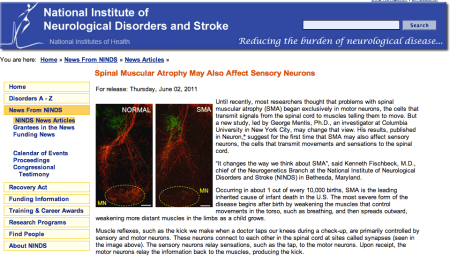
Until recently, most researchers thought that problems with spinal muscular atrophy (SMA) began exclusively in motor neurons, the cells that transmit signals from the spinal cord to muscles telling them to move. But a new study, led by George Mentis, Ph.D., an investigator at Columbia University in New York City, may change that view. His results, published in Neuron,* suggest for the first time that SMA may also affect sensory neurons, the cells that transmit movements and sensations to the spinal cord.

“It changes the way we think about SMA”, said Kenneth Fischbeck, M.D., chief of the Neurogenetics Branch at the National Institute of Neurological Disorders and Stroke (NINDS) in Bethesda, Maryland.

Click HERE or on the image below to read more…


New Approaches Open up in Spinal Muscular Atrophy

June 10, 2011

New Approaches Open up in Spinal Muscular Atrophy

PR Newswire | June 6, 2011

BOSTON, June 6, 2011 /PRNewswire-USNewswire/ — Spinal muscular atrophy (SMA) is the leading genetic cause of death in children under 2, with no treatment other than supportive care. In the Proceedings of the National Academy of Sciences (Early Edition, week of June 6), researchers at Children’s Hospital Boston show how loss or mutation of the SMA gene causes progressive muscle degeneration and weakness, and suggest a promising approach to treating the condition, sometimes referred to as a “Lou Gehrig’s disease of babies.”

Spinal muscular atrophy, or SMA, affects one in every 1 in 6,000-10,000 infants, but an estimated 1 in 35-40 people are carriers, according to the SMA Foundation. Infants with SMA are born with low muscle tone, and in many cases are too weak to breathe and swallow on their own; they usually die from respiratory failure.

The new findings reveal that loss of the SMA gene – and resulting depletion of a protein called SMN – makes nerve fibers from the spinal cord unable to navigate toward and form synapses (connections) with the muscles they’re meant to control. But they also demonstrate that this problem could be reversed in a zebrafish model of the disease.

Click HERE or on the image below to read more…


Cutting-Edge Research Saves Local Boy’s Life

May 24, 2011

Cutting-Edge Research Saves Local Boy’s Life

Danville Patch | May 22, 2011 | By Sarah Frank

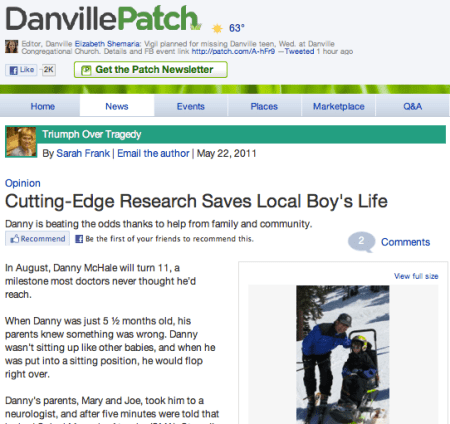
In August, Danny McHale will turn 11, a milestone most doctors never thought he’d reach.

When Danny was just 5 ½ months old, his parents knew something was wrong. Danny wasn’t sitting up like other babies, and when he was put into a sitting position, he would flop right over.

Danny’s parents, Mary and Joe, took him to a neurologist, and after five minutes were told that he had Spinal Muscular Atrophy (SMA), Stage II, and to take him home and enjoy him while they could. They were told Danny was what doctors termed a “weak type II” because he did eventually sit with assistance as a baby.

They got the devastating news no parents want to hear—it was terminal. They were told their Danny had three to six months to live, and they should make sure to get him baptized.

Click HERE or on the image below to read more…